Reflection Sessions on the Democratic State under the Law: ‘What does an offensive, future-oriented, and appealing democracy look like?’
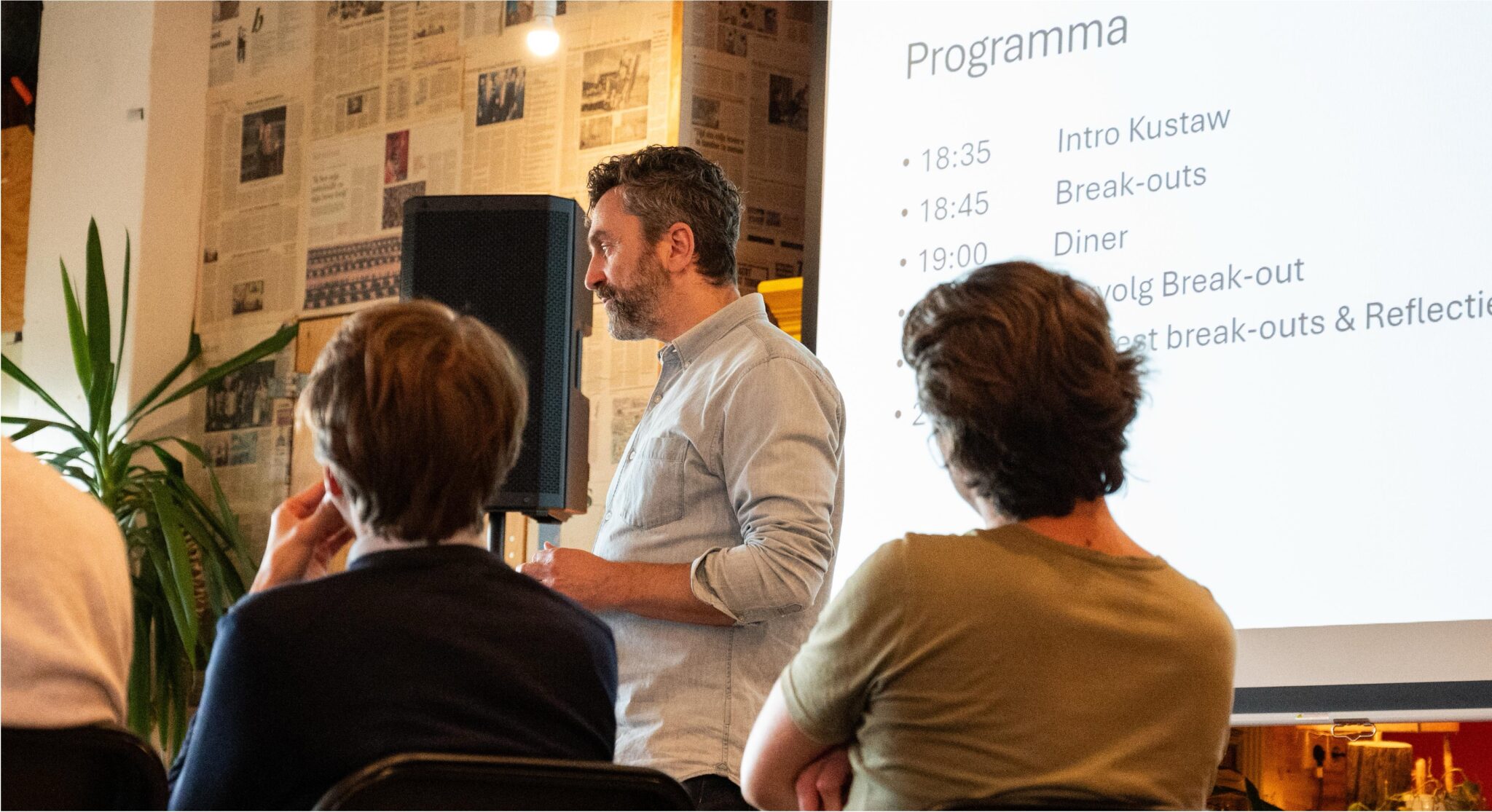
What does a proactive, forward-looking, and engaging democracy look like? At the initiative of the Democracy and Media Foundation, scholars, journalists, and artists engaged in a discussion on this question. Ali Al-Jaberi moderated the sessions and was supported in this role by writer, speaker, and advisor Kustaw Bessems. “Proactive democrats want to dethrone the new rulers.”
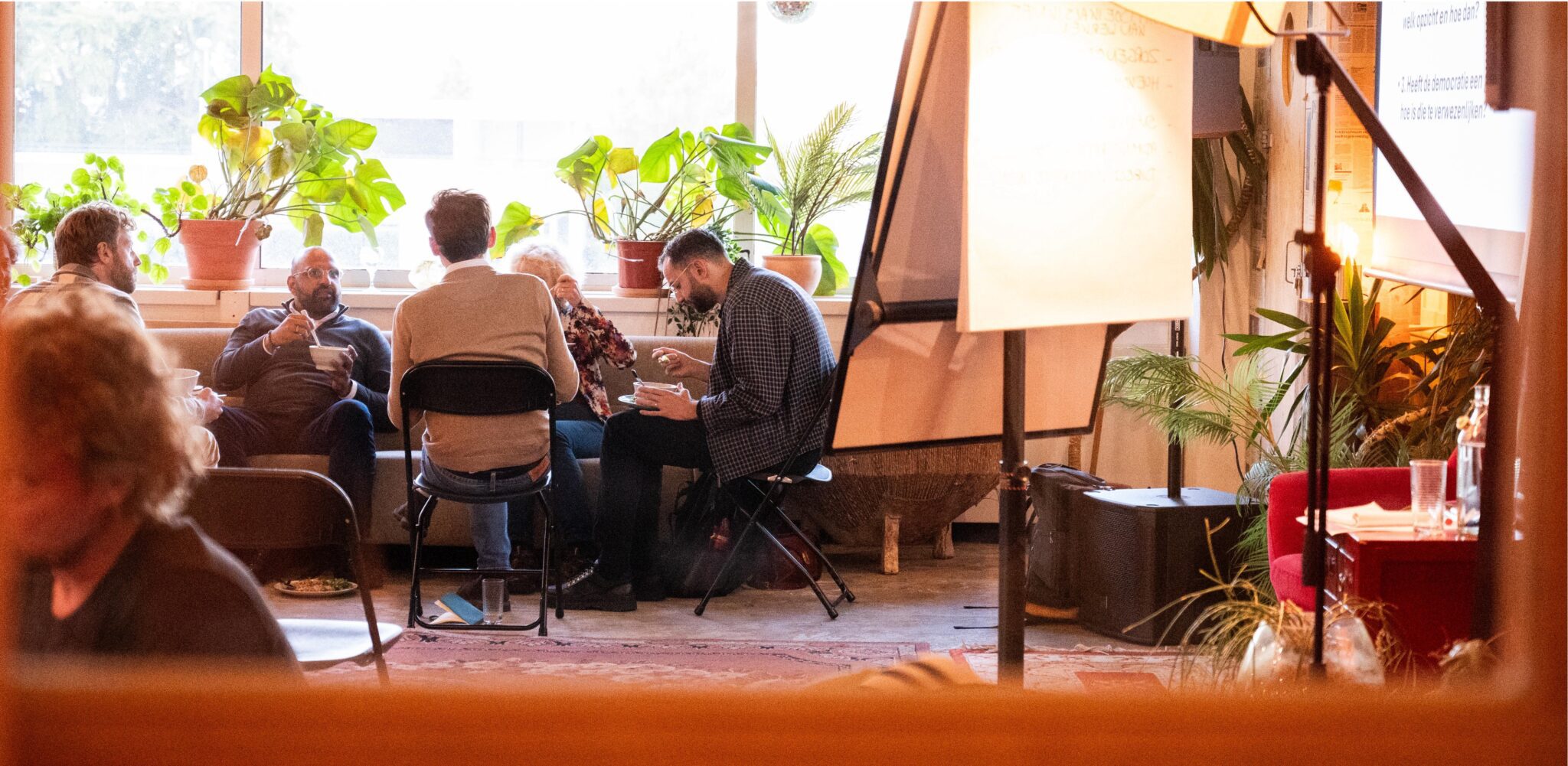
How can democracy move beyond a defensive stance? What does an offensive, forward-looking democracy that appeals to many people look like? At the invitation of the Democracy and Media Foundation, a group of people from very diverse backgrounds in the media, academia, and the arts reflected on this issue. During the four meetings, the discussions could get heated, but time and again, the conversation ultimately unfolded with curiosity. And that sometimes led to unexpected common ground.
The participants sought to break free from the way the debate on democracy is usually conducted today. In that debate, critics of the liberal democratic constitutional state argue, among other things, that the people—or a segment of the people—have not been sufficiently heard. In their efforts to assert a supposed will of the people, they undermine indispensable elements of the democratic rule of law, such as minority rights, an independent judiciary, and journalism.
In response to this, defenders of the liberal democratic rule of law spend a great deal of time pointing out all the things that are not allowed or not possible—either because of the law or because of treaties we are bound to uphold. Democracy thus seems primarily to be something that stands in the way of what many people want. Yet it exists to make things possible: to be heard, to be informed, to have your rights upheld. To be treated as equals. To have a chance to realize your ideals and win others over to your convictions.
Without giving the impression that this group—with such diverse perspectives—agreed on how democracy could be made stronger and more appealing, three distinct schools of thought could certainly be identified.
1. Democrats must fight against today’s concentrations of power.
Some looked on with a touch of envy at the revolutionary energy emanating today from populism and anti-democratic movements. After all, the democratic movement once possessed that energy itself: down with the monarch, the people will govern themselves! It has been recognized too late that, within liberal democracies, too much power has once again fallen into the hands of a small number of parties. Now it’s not monarchs, but tech giants and other international corporations that behave like a kind of superstate.
The fact that the entire world has become entangled in a web of interdependencies that is almost impossible to understand means that citizens feel they have even less say in matters. For some, the transfer of powers to the EU has distanced policy from their everyday lives, leaving them with the feeling that they are losing control.
In this complex interplay of forces, influence is unevenly distributed. A well-organized lobby can achieve far more than a citizen with limited resources and a small network. And the institutions that are supposed to uphold the rule of law protect some people far better than others.
So you could say that progressive Democrats want to dethrone the new rulers. They are critical of the downsides of global interconnectedness. And they are working toward a more equitable distribution of influence. This requires that citizens who are able to organize themselves actually do so. And that people who are unable to do so—because they lack the time or space—are better represented.
2. Celebrate the successes and keep striving for improvement
It was suggested, however, that our expectations of democracy are too high. Hasn’t democracy delivered on almost everything it can deliver? Isn’t it, at its core, simply a peaceful way of dealing with differences—and isn’t that remarkable enough? Shouldn’t that success be celebrated more?
Because there’s something unfair about it. When the government makes mistakes—or even when terrible events occur that are beyond anyone’s control—democracy as a system is quickly blamed. Yet things aren’t exactly any better in undemocratic societies. And perhaps that’s because we attribute too many lofty expectations to democracy.
Everyone present agreed that the benefits of democracy should be promoted more widely. But most people failed to grasp that democracy has reached a point where it will no longer be able to achieve much that is new. Democracy can do much more than simply maintain social peace, however significant that may be in and of itself. Democracy is the only system that can arrive at solutions that benefit people with seemingly conflicting interests. Citizens’ assemblies and local politics prove this in practice. Moreover, democracy is the only system in which you can be free. Pro-democracy advocates can be confident about all of this. That deserves more attention.
And this power of democracy could also be described in less cold terms. Sometimes it seems as if democracy is purely intellectual, a kind of technique. But as one of the participants pointed out: how does democracy become something to love?
3. Show what we share with each other, even in a personalized world, thanks to democracy.
On several occasions, a participant remarked that these conversations about democracy were in themselves also an exercise in democracy. At the first meeting, attendees could be startled by each other’s words, by what others are willing to sacrifice for a better democracy. But regarding this, too, participants came to understand each other increasingly well as the meetings progressed.
In a way, that was encouraging, but it also starkly illustrated just how daunting the challenge is outside the safe space of such a series of meetings. Here, people were given ample time to ask each other questions and explain things to one another—under the guidance of a moderator, no less. Citizens don’t have that luxury in their daily lives. And everyone was aware that there are far wider divides in society as a whole than within this group.
What you encounter online is increasingly tailored purely to you as an individual through personalized AI. We must assume that, in the future, people will never again encounter anyone who consumes the same information as you do. And that is why it is absolutely essential for progressive Democrats to demonstrate that the liberal democratic rule of law can work well for an infinite variety of people—for you, and also for people with whom you think you have nothing in common.
More about who we are and what we do