Meeting on Improper Election Interference: ‘Preventing autocracy is our bottom-line interest’
Democracy can only thrive if citizens can rely on information that has not been manipulated or intended to mislead. That is why, on September 19, 2025, the Democracy and Media Foundation organized a meeting on improper election interference, bringing together some thirty regulators, academics, lawyers, government officials, members of civil society, and (chief) editors.
The main question of the meeting was: What can we expect in the run-up to the House of Representatives elections, and are we sufficiently prepared for this?
Why this meeting?
In November 2024, more than two million Romanians voted for a previously unknown, pro-Russian, far-right presidential candidate. Following revelations of manipulation and foreign interference, these elections had to be rerun. Other European countries were warned that Romania was being used as a testing ground. In February 2025, there were serious concerns about foreign interference in the German Bundestag elections, including through “news sites” that were created out of thin air using AI.
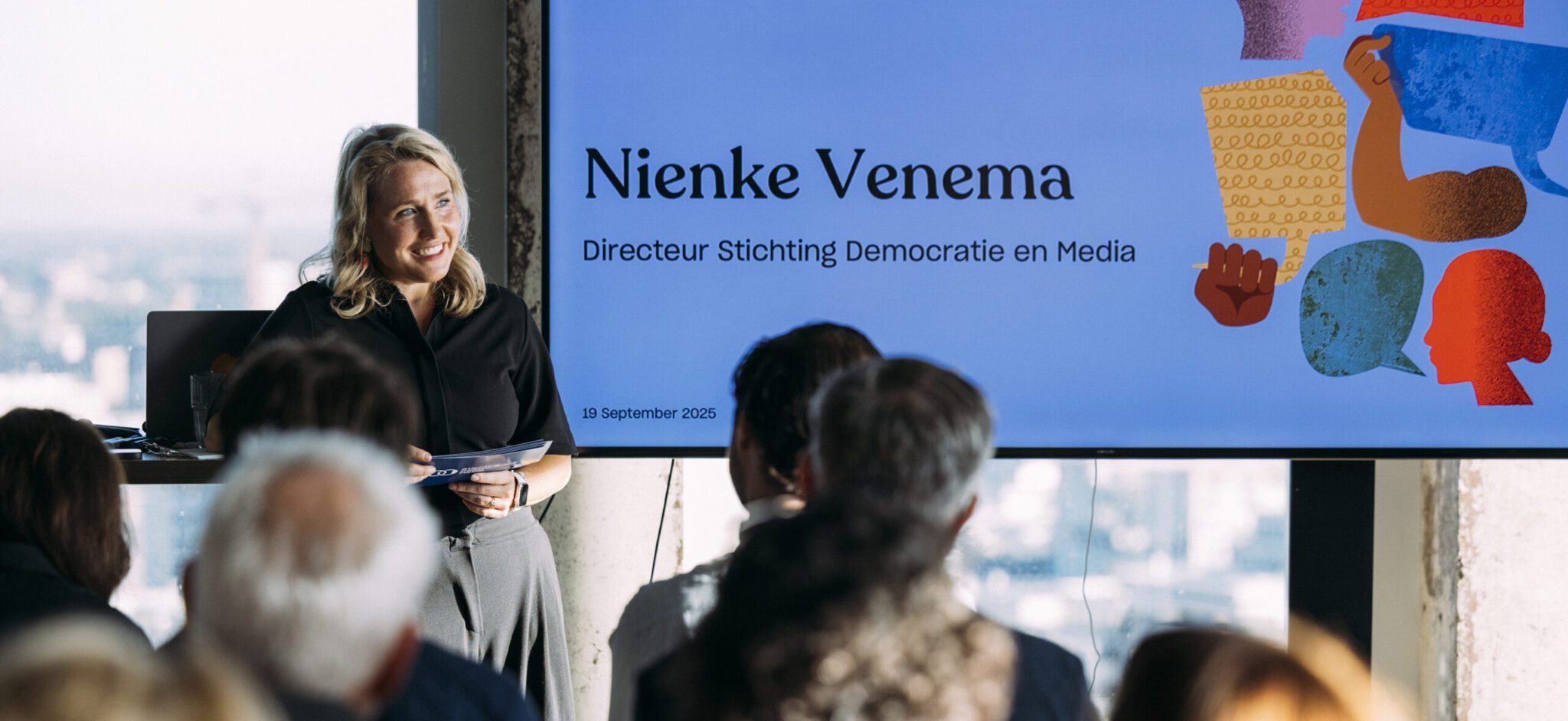
Based on the conviction that the Netherlands is not immune to this and that we must not be naive about it, the Democracy and Media Foundation organized this meeting to discuss how our public debate can be protected, especially during election season. How can we ensure that it remains open to everyone while also being resilient against manipulation? And where do we draw the line? Europe is attempting to counter the harmful effects of social media and AI through legislation, but the possibilities are limited.
“We’re talking about anti-democratic movements that play by the rules very well—until they no longer have to.”
Substantive contributions
Speakers Jelle Postma (Justice for Prosperity) and Pieter van Boheemen (Post-X Society Foundation, Democracy Monitor Foundation) provided a substantive framework. Using concrete examples from the Netherlands and abroad, they provided insight into online attempts to influence public opinion and the actors behind them.

Van Boheemen demonstrated that ChatGPT is also a channel for spreading disinformation. Through what is known as “LLM grooming,” a network of Russian actors is attempting to influence the outputs of language models. Postma emphasized the existence of an “unholy alliance”—groups with differing interests that reinforce one another. According to him, disinformation and influence operations are also simply means of sowing fear and throwing a wrench in the works of democracy.
Seven Insights
In a group discussion, representatives talked about what exactly we mean by “undue influence on elections” and what actions can be taken to prevent or counteract it. In breakout sessions, participants delved deeper into everyone’s role in this regard, both in the run-up to elections and afterward. A strong sense of responsibility was felt: “Our shared bottom-line interest is preventing autocracy.” The discussions yielded seven insights.
1. Improper is by no means always illegal
Establishing improper election interference is no easy task. For ‘99% of the things we see fall within the law, but when added together, they are indeed harmful,’ according to one participant. Another notes: ‘Often it involves anti-democratic movements that play by the rules very well, until they no longer have to.’
2. Influence has always existed, but its potential impact can be particularly significant today
Thanks to the internet, the speed at which attempts to influence others occur and their potential reach have grown exponentially. “We’ve been in a digital war for 10 years now, but we’re moving very slowly. Many measures are reactive and therefore ineffective,” said one participant. These often involve online activities that, on their own, are difficult to link to a specific goal. Consider AI-generated content that reinforces negative stereotypes, the flooding of TikTok with fake accounts, and ChatGPT being used as a distribution channel by flooding these large language models with biased text.
3. Don’t let panic over influence have a greater impact than the influence itself
Fear is used as a tool of power, according to Jelle Postma of Justice for Prosperity. The goal of disinformation and influence is sometimes simply to cause disruption. We must therefore avoid overreacting to it or in our reporting on it, as this can be more harmful than the actual influence itself. It’s a fine line: don’t be naive, but don’t be overly alarmist either.
4. We can’t leave this up to government agencies alone
One participant notes: “The example of Romania also shows that it’s risky to decide after the fact that elections didn’t go well. When you cancel elections, you’re playing right into the hands of anti-institutional actors.’ This could sow even more doubt about the legitimacy of democratic elections. Governments must therefore exercise restraint in their actions. They have a range of tools at their disposal (such as the DSA and the GDPR), but should not act as a “Ministry of Truth.” Not only is this disastrous for public debate, but it also plays right into the hands of anti-democratic actors.
At the same time, legislation is barely keeping pace with developments, regulators are overwhelmed, and the largest platforms where attempts at influence take place are not under European control, let alone Dutch control. Everyone has a role to play in identifying and countering improper influence. In short, we cannot leave this solely to the government.
5. Signaling must come from the entire society.
Existing regulations can be better enforced when online activities are reported by the public, as is already happening in neighboring countries. Regulators are actively seeking ‘trusted flaggers’ who can report illegal and inappropriate content.
6. We need digital alternatives
In addition, the government can set a different example by ceasing to provide information through major non-European platforms at all levels of government. “We must build alternatives. This is about our strategic autonomy and digital sovereignty.”
7. We all need to become more media-savvy
“We need very sharp editorial teams. And as media outlets, we need to be much more critical of one another. Journalism has not only a reporting role [describing what happens, ed.], but also a watchdog role. When a politician says something, we shouldn’t just accept it at face value.”
Fact-checking, debunking, and prebunking are necessary, as is investing in the public’s media literacy, but they are not a silver bullet. “What is the point of the truth anymore?” one participant wonders. “Amid the clamor of identity and culture wars, the truth is no longer compelling—after all, people already have their own truths. They’re mainly looking for confirmation of them.”
Thankyo
This event would not have been possible without the meticulous efforts and professional guidance of Isabelle Rade, Maarten van Heems, and Maxence Vrede from the BKB campaign agency.

News and articles