Writer and historian Ewoud Kieft: ‘The populist narrative of one people with one will of the people is a fairy tale’
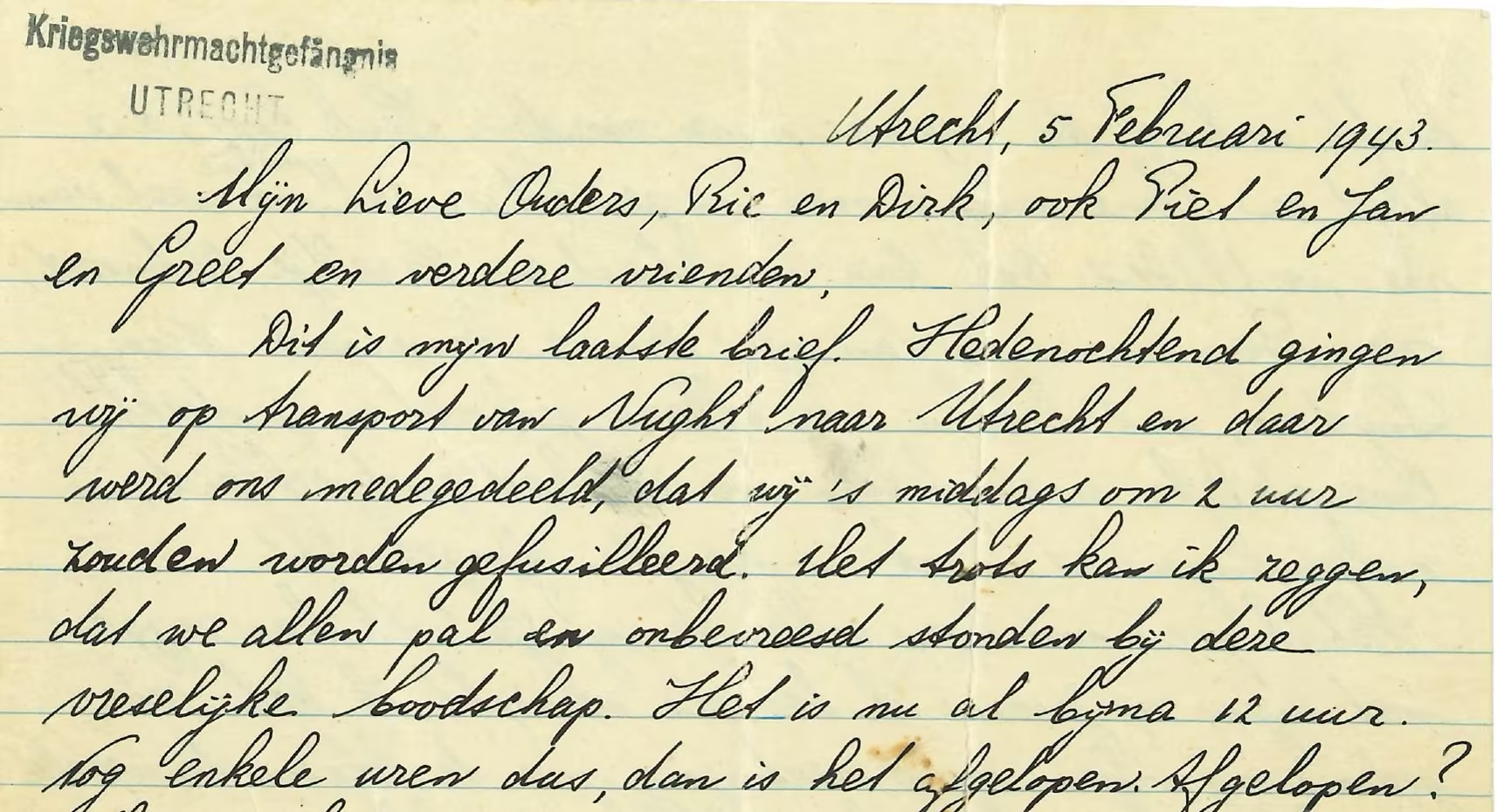
Writer and historian Ewoud Kieft was invited by the Democracy and Media Foundation to speak at the February 5 commemoration, which honors the staff of the resistance newspaper *Het Parool *. Speaking to an audience of family members and other interested attendees, Kieft discussed the “unwavering, everyday discipline” that characterized the resistance. He also spoke about the need for resistance now that autocracy is on the rise worldwide. Kieft’s full speech can be read below.
Text: Ewoud Kieft
It’s truly special to be here among you today, at the commemoration at the Cemetery of Honor, and now here, surrounded by so many family stories. It also brings back memories for me from more than twenty years ago—when I got to know a few people from that old Parool group. I remember being at Max Nord’s home one twilight afternoon for an interview. He was nearly ninety at the time. But he was remarkably youthful in his demeanor—cheerful and easygoing. It almost felt as if I were talking to someone my own age. His eyes sparkled, especially when he reminisced. He poured me jenever and wine, even though he wasn’t allowed to drink anymore himself, he said with some regret.
A few years later, I met Wim van Norden. We spoke briefly. He was too old to walk anymore, but he, too, still had that boyish, lively spirit in his gestures and in his thoughts. He switched topics quickly, said all sorts of things that I was still thinking about days later, and he was curious—which is something not all people at that advanced age still are.
I’m reminded of those encounters because they confirmed the impression I already had of that old Parool group: a cheerful, lively, curious group of people—that image was already in my head, and I think that was due to the stories by Simon Carmiggelt, who sometimes wrote about them—and whom I’m still a big fan of—and to that wonderful interview with Annie M.G. Schmidt, conducted by Ischa Meijer, in which she talks at length about the people at *Het Parool* among whom she found herself. Before that, she had been a “mossy piece of wood,” she said.
But she finally shook off that “dull” vibe in that crowd full of cheerful debauchery. “They were all like, ‘Come on, guys, let’s do this’ and ‘Let’s have some fun cheating,’ ‘Let’s get drunk,’ ‘Let’s do fun things.’ They had a ‘strong sense of politics, a tremendous drive to finally get things right.’”
But beneath all that carefree cheerfulness lay a certain gravity, a sense of shame—Annie M.G. Schmidt even called it “the collective shame that you allowed that to happen.” All those Dutch people, those fellow citizens, who happened to be of Jewish descent, who were torn from their community, deported, and murdered. It still weighed on her decades later; she felt a pain in her stomach whenever she thought about it.
It is that combination of joyful exuberance on the one hand, and deep compassion on the other—and the pain of having failed to protect their persecuted fellow citizens.
The realization that the persecution of the Jews involved fellow citizens —that Dutch Jews were part of the same community—was precisely what was lacking among the majority of the population in the Netherlands; even after the liberation, you could still see that—yes, even in some resistance circles, Jews were still viewed as fundamentally different.
National Solidarity
Not in the report that *Het Parool* published on the raids in Amsterdam’s Jewish quarter and the first acts of resistance that ultimately led to the February Strike. It is striking that the author, Frans Goedhart, explicitly referred to fellow citizens as the focus of the resistance: “Workers, students, the unemployed, and office workers flocked to Waterlooplein to help their threatened Jewish compatriots (…)” “This was the unity of the Dutch people, who rose up in resistance to protect a threatened segment of the population against the Germans and their henchmen.”
“The realization that the persecution of the Jews involved fellow citizens—that was precisely what was missing among the majority of the population in the Netherlands.”
It may seem like a minor detail, but it is a significant departure from the language typically used during this period—in which phrases like “those Jews,” “that Jew,” and various other expressions always emphasized that they were outsiders, not full-fledged Dutch citizens.
Het Parool did, however, cherish that national solidarity—as Madelon de Keizer demonstrated in her book about Het Parool. That idea of a broad, national resistance movement, in which all the different groups in society played a part and stood up for one another, was a driving force behind HetParool’s idealismfrom the very beginning. And that set it apart from many other resistance groups. Those groups often operated within very closed subcultures, centered around the church or the Communist Party. These were resistance movements that sometimes strayed very far from liberal democracy.
I discovered that when I began researching the resistance group my grandfather had been active in. It was the Nulgroep in the city of Groningen. Many of those resistance groups in Groningen had emerged from church-based organizations—Bible study groups, Reformed youth groups. That was undoubtedly how my grandfather became involved as well. He came from a deeply Reformed family and was himself a devout believer. When his first wife died, he wrote devotional poems full of trust in God.
For those resistance fighters in Groningen, their decision to go underground revolved around deeply religious ideas: for them, resistance meant first and foremost a struggle against “the satanic nature of National Socialism, which threatened to destroy our highest spiritual and national values.” That is exactly how they described it. Nazism, with its biological ideas about race and the primal forces of the Germanic people—which would rise again once Germany had been purified of racial mixing and foreign influences—was a form of paganism that Christians had to oppose to the utmost. Resistance was nothing less than a “spiritual battle against the Devil.”
That was a completely different kind of resistance than the social-democratic ideas you often encountered in the Parool Group—which were occasionally supplemented by some general Christian-humanist ideas (as seen, for example, in the works of Nord and Van Norden)—and also entirely different from the hard-line Marxists of the communist resistance.
At times, these were irreconcilable worlds—the different branches of the resistance—as became clear, for example, when my grandparents took in two workers from the communist resistance to hide them. It didn’t go over well at all. And when they said goodbye—because they were moving to a new hiding place—the workers refused to say thank you. After all, my grandparents had done nothing more than their duty—and, when you think about it, that’s not something you should have to thank someone for.
That story always makes me laugh. Because those Reformed resistance fighters were exactly the same way themselves. When medals and decorations were handed out left and right after the liberation, there was grumbling within the LO: actually, what they had done shouldn’t be considered anything out of the ordinary—all those medals sent the wrong message: it almost made it seem as if the passivity of the rest of the country was normal.
“When they moved to a new hiding place, they refused to say thank you. Because my grandparents had done nothing more than their duty—and, when you think about it, you shouldn’t have to thank someone for that.”
Unwavering convictions—they all had them, no matter how different the resistance groups were. And that was necessary, of course. If only because of the risks associated with resistance work. The risk of being arrested, imprisoned in a concentration camp, and interrogated by the Sicherheitsdienst, which was very eager to learn the names of other resistance fighters. You had to hold onto some kind of ideal to be willing to risk all that.
Monotonous
And perhaps an unshakable conviction was even more necessary because of something that isn’t often mentioned when it comes to resistance, but which was an essential prerequisite for it to function at all: discipline. Unflappable, everyday discipline. It’s an aspect that receives far less attention than all the spectacular acts of resistance—raids on distribution offices, attacks on high-ranking Nazis. But the bulk of the resistance work—the vast majority—was much more monotonous. Ration coupons had to be distributed, money collected, newspapers printed, folded, stored, and distributed—every day, week in and week out. Cycling through the city or the countryside, delivering everything neatly to the right addresses, getting home on time, and not drawing too much attention.
The fact that *Het Parool* grew from a small mimeograph sheet to a circulation of 100,000 during the final year of the war is a testament to an incredibly disciplined organization. Just consider the logistical operation involved in pulling that off entirely underground: the supply of paper, the printing presses, the entire distribution network—finding replacements when staff members were arrested, constantly coming up with new aliases and new safe houses.
And the same was true of the resistance in the province of Groningen. There, in the summer of 1944, there were 18,000 people in hiding who needed to be cared for. They needed ration coupons and money. In the city of Groningen, the Nulgroep collected an average of 15,000 guilders each month through a so-called “pot system”: each member of the resistance group’s financial branch asked five people for money, who in turn approached five other people. Not only people in hiding, but also families who had lost their breadwinners were supported in this way, with about 10 to 30 guilders per month.
All of that had to be delivered on time. And my aunt, for example, was put to work on that, too. She was ten years old at the time and had to walk all the way across town with a stroller full of ration coupons. Later, she told me that her shoes were too tight. They were two sizes too small. That might seem like a minor detail. But it isn’t, when you have to walk around in them for hours every day.
The resistance often had more to do with perseverance, logistics, and bookkeeping than with the romantic image of reckless freedom fighters. And that is exactly how W.F. Hermans portrayed it in his famous war novel *The Dark Chamber of Damocles*. In it, Hermans introduced a down-to-earth resistance fighter, Labare, who wanted nothing to do with all the pompous romanticism surrounding the resistance: “You have to view this work as just a job; you shouldn’t sit around thinking all the time: it’s war, I’m a hero, and so on. (…) What is a hero? Someone who has been careless with impunity. We have no use for careless people.”
That single sentence—“What is a hero? Someone who has been reckless with impunity”—was later quoted endlessly as if it were a derisive remark by Hermans himself, intended to deny the heroism of the resistance. But that is not at all the implication in the novel—through the words of a practical man of action like Labare, who shunned grand rhetoric, Hermans actually provided a very realistic portrayal of what resistance work looked like in practice.
“Raids on distribution offices, attacks on high-ranking Nazis. The bulk of the resistance work—the vast majority—was much more monotonous.”
And Hermans himself had picked up on some of that as well. His next-door neighbor on Eerste Helmerstraat in Amsterdam, Henk Jonkman, was a resistance fighter for the Amsterdam branch of the LO. Hermans often dropped by; he picked up on hints that all sorts of clandestine activities were going on, but he never found out exactly what. Jonkman was a loyal reader of *Het Parool*. In his diary, he recorded everything he could find out about the deportations of Jews from the city. The famous *Het Parool* article of September 27, 1943, which reported on extermination camps with gas chambers, hit him like a bombshell. It confirmed the rumors he had heard months earlier. He wondered why Radio Oranje wasn’t broadcasting the news. If they had, the resistance in the Netherlands would have grown much stronger.
Pompous Kitsch
Jonkman, too, was an idealist with unshakable convictions—a social democrat attuned to the humanistic Christianity of radical charity and self-sacrifice. One evening, he and the young W.F. Hermans got into a heated argument over the resistance poetry that appeared in clandestine anthologies during the occupation. Hermans thought it was all pretentious kitsch.
These were poems like this one:
“May our deeds have been good,
– or perhaps wrong as well –
to sacrifice ourselves for a higher purpose
At least that’s what we’ve learned.
Isn’t this the meaning of life?
– and perhaps also of death –
to learn to give of ourselves
“in times of need?”
And even though Jonkman also considered this poetry to be poor by literary standards, “the fact that they were written by people in prison, ‘between the barrel of a gun and the wall,’ as one of them is titled, makes them sacred to me.”
Down-to-earth discipline and lofty idealism are not mutually exclusive. That’s what struck me about the resistance circles in Groningen, of which my grandfather was a part. My grandfather, who sang psalms in the Sandbostel concentration camp, where he was sent after his arrest, and where he died of typhus in May 1945.
And when you heard his fellow resistance fighters talk about the struggle for God and country, it sounded rather pompous—only to hear them say, almost laconically, right after that, that their rule of thumb was that if members of your group had been arrested, you had to be in your hideout within 24 hours. Because 24 hours—that was about how long you could expect someone to withstand torture; after that, you couldn’t reasonably expect them to keep their mouth shut. So by then, you had to be gone. That’s how it goes.
Obsession
The history of the Second World War has actually never truly become history. From the moment of liberation to the present day, it has remained a benchmark against which we measure current events: Nazism has taken on many new forms during that period: in the 60s and 70s, just about every police officer was branded a fascist – and the protest generation identified – in a not-so-sober manner – with the resistance. After that, the Islamic terrorists, the populists, Putin, Xi Jinping, Fortuyn, Wilders, Frans Timmersmans, Trump, the World Economic Forum, were all the new Nazis.
I don’t mean to lump all those comparisons together and ridicule them all. There is—especially in recent years—indeed a serious anti-democratic trend underway in the world—and at the same time, we must acknowledge that the comparison to Nazism has been used so eagerly over the past eighty years that, whether we like it or not, it has lost much of its power.
What we are currently witnessing in the world, in terms of geopolitical relations, is, in a sense, precisely the end of the postwar era in which Nazism and the resistance served as self-evident points of reference. We are witnessing the end of the period in which the memory of the horrors of World War II ensured the self-evident nature of the international legal order, the self-evident nature of an open, pluralistic society, the self-evident nature that brute power politics and intimidation had no place in civilization, and the self-evident nature that in a democracy, power does not lie with a leader or a party, but in the law.
Those days of taking things for granted are over. And that is causing many people right now to genuinely fear a repetition of history, a resurgence of fascism. The newspapers have been full of this for years; writers, artists, and filmmakers are all speaking out about it. We can’t say we weren’t warned. Our culture is truly brimming with dire predictions, stories about the resurgence of fascism and autocracy—we’ve truly been saturated with images of fear and visions of doom over the past few decades.
“The history of World War II has never really become history.”
And we have to admit that it hasn’t worked. It hasn’t curbed nationalist-populist politics—on the contrary—I think it has only helped the radical right. Because—with our obsession with World War II, our collective fear of its recurrence—we have created a democratic culture that is negative, one held together by visions of fear and images of the enemy. We have defended freedom and democracy by warning—constantly warning—against their opposites. Democracy is important, because otherwise you get fascism and war.
The positive narrative about democracy has been lost sight of. And that positive narrative is needed more than ever. At its core, that narrative is not at all worrisome or defensive. It is a narrative full of zest for life and grounded in sober realism. Because democracy is the only form of government that does justice to reality. And the reality is this: the population—“the people,” as the populists call them—does not consist of people who are all the same, and certainly do not all think the same way—just imagine: how terrible that would be—but that is precisely the fairy tale that populists and dictators want us to believe: that the people speak with one voice. That “the people” want the same thing. As if the people weren’t made up of all kinds of different people, groups, interests, beliefs, and ideas.
I haven’t even come across a single family in which children, parents, grandparents, cousins, and nieces all think the same way about everything. That diversity of opinion—that’s what democracy is all about in the first place: doing justice to all those different opinions and ideas. So that we don’t have to lie, so that we don’t have to pretend to be something we’re not.
That is what a democratic culture essentially is: a multitude of different beliefs, worldviews, dreams, and mundane material interests—and from that multitude of clashing elements, we try every day anew to forge something coherent.
That is also what reality consists of, when viewed from a physical perspective: colliding particles. That is what you must recognize when you look at our society in a sober and realistic way: it is not an artificial uniformity imposed from above. No, it has always been a multitude of particles. And the beauty of nature is that these colliding particles do not cause deterioration or decay. No: colliding particles generate energy. They generate heat. They are the building blocks of everything that exists.
That’s not a flimsy argument, but the only level-headed and realistic way to view reality; a democratic culture is one full of dynamism and vitality, of colliding particles—the very building blocks of reality, and the ultimate source of all energy.
The populist narrative of a single people with a single will is a fairy tale that has nothing to do with reality. And yet, the democratic narrative often struggles when it has to compete with these populist fairy tales. How is that possible?
In *Mein Kampf* , Hitler analyzed the weaknesses of democracy: and, in his view, the greatest weakness was the very fact that, in a democracy, different parties with different ideas had to reach compromises with one another after the elections. People didn’t like that. When it came down to it, most people were still drawn to uncompromising fanaticism—the power of inner conviction—rather than half-hearted, weak indulgence.
And Hitler had a point there. Especially in the Weimar Republic of the 1920s and 1930s, there were simply too few people who were passionate, committed democrats. That was also the conclusion reached by Sebastian Haffner, Hitler’s razor-sharp contemporary and critic: “He achieved all his successes against opponents who were either unable or unwilling to offer any real resistance.”
That was a harsh judgment, but a fair one: Haffner wasn’t referring to the socialists and communists, who were immediately and mercilessly persecuted by the Nazis—he was talking about all those centrist parties in the Weimar Republic that voluntarily disbanded in the spring of 1933: the liberals and the Christian Democrats. They showed no fighting spirit whatsoever, but drew their own conclusions of their own accord. They lay down on the ground and offered no resistance at all, because they thought that resistance would be pointless anyway.
Kneeling
We have seen a shocking amount of that attitude of giving up in advance over the past year, especially in the US: (Big Tech) companies, law firms, university boards, the Secretary-General of NATO (our former Prime Minister Mark Rutte)—they knelt because they thought there was no other realistic option. While we know from history that autocracies and dictatorships can only establish their power if there are enough people who believe that the only option is to kneel. From the moment people simply refuse to do so, out of the strength of their conviction, the autocrat’s power immediately begins to splinter.
That’s what resistance does: as soon as there are enough people who simply say “no”—in parliament, in the judiciary, and above all, among the general public—the narrative of a president who is carrying out the “will of the people” immediately takes a hit. That is precisely the weak spot where populist leaders are far more vulnerable than we often realize.
The old resistance groups can serve as an example here; their history—that of the Parool Group, the Nul Group, and all those other groups in Groningen and the rest of the Netherlands, as well as that of steadfast resistance fighters like Henk Jonkman—is perhaps more relevant than ever.
They show us what the conditions for effective resistance are, how it comes about, and above all: how you can make it work.
- The Power of Inner Conviction
- Their level-headedness, their realism, their discipline
- And their diversity: from strictly Reformed to Communist to Social Democratic (with a touch of Christian humanism) –
These were groups that would never see eye to eye, and so that was never the goal. The whole idea of democratic resistance is precisely that it is multifaceted—that it does not have to be uniform, nor should it be . That diversity is precisely what we must protect. And that means recognizing allies and fellow fighters in those with whom you passionately disagree—that was what *Het Parool* meant by its motto of national solidarity. A broad, multifaceted resistance, rooted in the realization that all those different viewpoints and groups were represented and comprised of fellow citizens—people who were part of the same community. And that we refuse to label anyone—no matter how much we disagree with them—as alien to us.
That was the resistance of the people we are commemorating today. And therein lies a rich source of inspiration for the forces of democracy—forces that we still desperately need today.
More about who we are and what we do