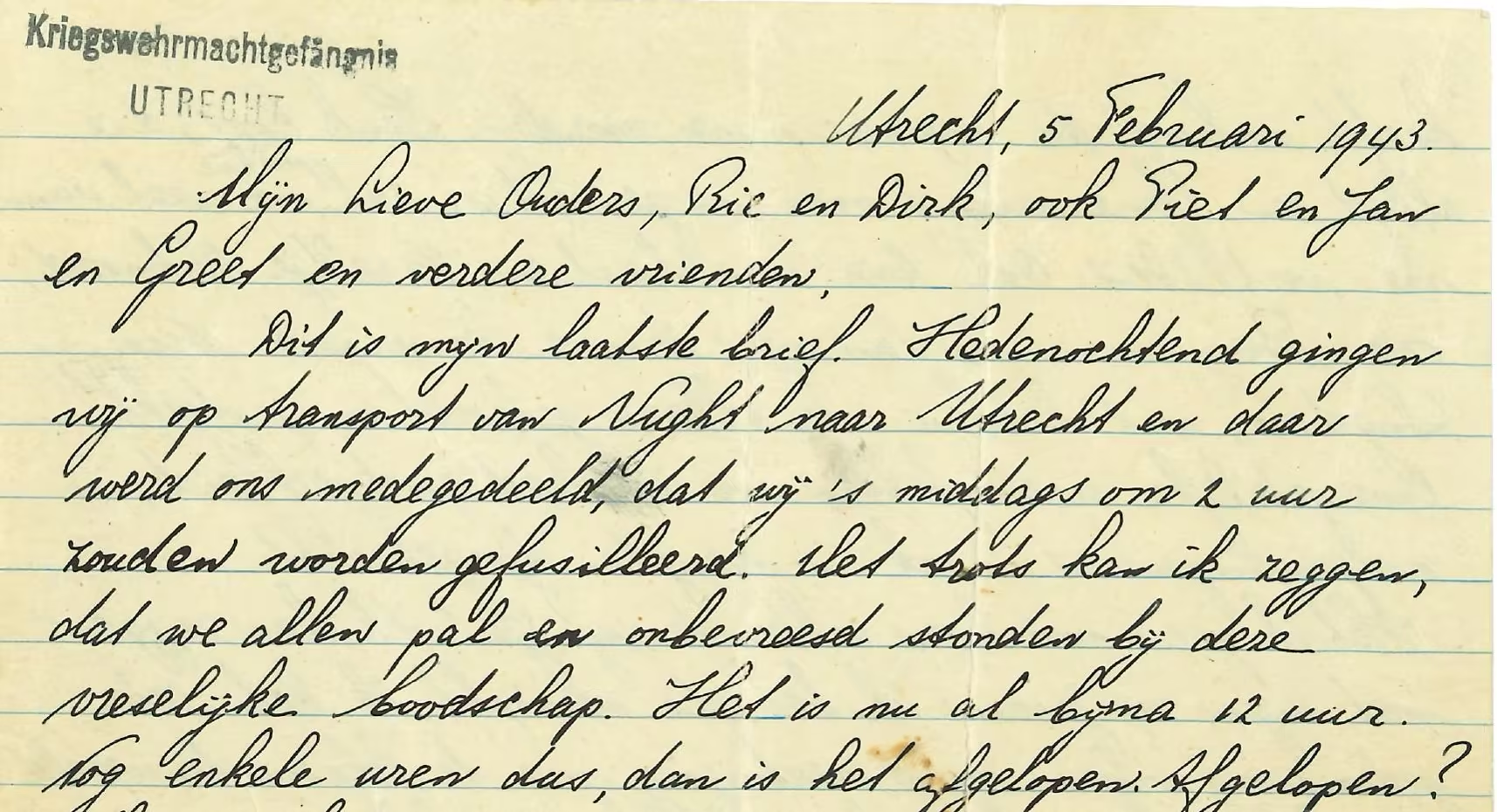
Today marks the release of the book ‘Vrij, Onverveerd’ in honor of the 85th anniversary of Het Parool
On February 10, 1941, the underground resistance newspaper *Het Parool* was published for the first time. Today, exactly 85 years later, the book *Vrij, Onverveerd* is being released. Powerful portraits of journalists show that a free press is not a given, but a hard-won achievement. The Democracy and Media Foundation, which grew out of *Het Parool*, took the initiative for this project, together with Emilie Nord and Suzanne van Norden, daughters of *Het Parool* journalists Max Nord and Wim van Norden.
*Vrij, Onverveerd* was written by Teun Dominicus and Peter de Brock. The book features portraits of men and women who worked in the utmost secrecy for the underground newspaper *Het Parool*. These are juxtaposed with a series of mirror portraits of contemporary journalists from various parts of the world. Intimidation, threats, violence, and political subversion hinder their journalistic work. Although these stories do not correspond exactly with those of the *Parool* staff members, together they take on new meaning.
Below is a profile of Jet Roosenburg, who provided the *Parool* editorial staff with vital information during the war.
You can read other portraits from *Vrij, Onverveerd* here:
- Frans Goedhart (1904–1990), who continued his journalistic work even while in prison
- Wim van Norden (1917–2015) had already begun thinking at an early stage about how the underground newspaper *Het Parool* could continue to exist after the war
- Max Nord (1916–2008), the poet who became a journalist because of the war
- Simon Carmiggelt (1913–1987) was involved with the resistance newspaper *Het Parool* from the very beginning
- Emmy Andriesse (1914–1953), the photographer who captured the little boy with a pan in front of his stomach
- Jaap Nunes Vaz (1906–1943), who was fired the day after the Dutch surrender, was one of the founding journalists of *Het Parool*
- Kees de Groot (1913–1945), whom the Germans executed without knowing that he was the *Parool* staff member they had been searching for for years
*Vrij, Onverveerd* is published by *Het Parool* and was produced with support from the Democracy and Media Foundation. The book can be ordered here (proceeds go to the editorial staff of *Het Parool*).
The Woman Who Was Erased from the History Books
As a student at Leiden University, Jet Roosenburg became involved in the resistance. In 1941, she organized the distribution of the underground newspaper *Het Parool* in The Hague. That same year, she was the only woman invited to an interview with Frans Goedhart, who was looking for new editors.
Just as Professor Eduard Meijers was about to give a lecture in November 1940, Rudolph Cleveringa, dean of the law school, took the stage at the Academy Building on Rapenburg in Leiden. A few days earlier, all “non-Aryan” civil servants had been dismissed from their positions, including the Jewish staff members of the country’s oldest university. Earlier, 1,700 of Leiden’s 2,400 students had signed a statement addressed to Reich Commissioner Arthur Seyss-Inquart, declaring that the dismissal of Jewish staff “directly contradicts the traditions and freedoms” of the university. That letter to no avail. With pent-up anger, “like boiling lava” in his head, Cleveringa spoke about the dismissal of his mentor, Meijers. The purpose of the law is justice, he told his audience, and exclusion on the basis of religion violates the fundamental principle of the Constitution.
Cleveringa has been informed of an impending student strike should Meijers be dismissed, and he wholeheartedly supports that strike. Nevertheless, he feels it is wise— Feind hört mit (the enemy is listening)—to warn his audience not to resist, knowing that his students will ignore that message. “Without resorting to futile follies—which I must strongly advise you against—we can do nothing now but bow to the overwhelming force.”
One of the students present at Cleveringa’s protest speech was Henriëtte Jacoba Roosenburg, known as Jet. She was born on May 26, 1916, in The Hague into a family of patricians and nobility. As a rebellious and headstrong teenager, she already displayed literary talent and a knack for languages. Nor was she entirely unfamiliar with a thirst for adventure. In the school newspaper of the elite Nederlandsch Lyceum in her hometown, she wrote stories that—
—did not immediately align with the social milieu from which she came. In early May 1940, the then 23-year-old Roosenburg was studying language and literature at Leiden University, where she was also learning Spanish, French, and Russian. Together with her college friend Thea Exalto, she became involved in the student strike and began focusing on resistance work.
Relegated to a footnote
During the second year of the occupation, Roosenburg helped distribute copies of *Het Parool* in The Hague. She was responsible for distributing 200 copies in the capital. Apparently, *Het Parool* editors Jaap Nunes Vaz and Lex Althoff were so impressed with her work that Roosenburg was invited to an interview with founder Frans Goedhart for potential new editors. In December 1941, she attended the interview—along with future editors Kees de Groot, Jan Meijer, and Wim van Norden—and was treated as an equal to the men, according to statements by Meijer and Van Norden, among others.
Why this striking mention? Because Roosenburg’s presence—as the only woman in that room—has been erased from the history books: specifically, from the standard work *Het Parool 1940–1945*. In *Resistance Newspaper in Wartime*, she has been relegated to a footnote. In the accounts of *Het Parool* during the war, men are primarily in the foreground, while women are mainly depicted as couriers and distributors of the newspaper.
Although Roosenburg did not join the newspaper’s editorial staff after the aforementioned meeting, she did gather news for the editor-in-chief via illegal radio stations from January 1942 through August 1943. Her contributions were very welcome: In the fall of 1942, De Groot was briefly the only Parool editor still at large. Starting in the winter of 1942–1943, he received assistance from Gerrit Jan van Heuven Goedhart, the former editor-in-chief of the *Utrechts Nieuwsblad*. Roosenburg wrote detailed letters to both editors, providing up-to-the-minute updates on developments at the various fronts. In January 1943, Roosenburg reported to Van Heuven Goedhart that the Battle of Stalingrad was proceeding slowly: fighting was taking place “street by street and factory by factory.” Roosenburg also learned on January 18 that “the siege of Leningrad has been broken. The Russians have advanced here across the Neva and along Lake Ladoga and have reestablished contact with their own troops for the first time since September 1941.” A few days later, she wrote to De Groot about advances on the front around Kharkiv in Ukraine, where a “German line” had been broken.
Roosenburg also reports in detail on the fighting between the German Afrika Korps and the British forces led by Bernard Montgomery. She mentions air raids on cities and the capture of military bases by French camel troops. Around the time of Tripoli’s liberation, on January 20, 1943, she emphasizes just how vast the territory is that the British have captured from the Italians. “Entered Tripoli. The entire Italian colonial empire (12.5 times the size of England) is now in Allied hands. Distance from El Alamein to Tripoli = Leningrad to Paris. Covered in 3 months.”
Roosenburg not only reports on the progress on the battlefield, but also provides information about the diplomacy behind the war. In Casablanca, several Allied leaders gather to discuss their war strategy. The ultimate goal is clear: only a complete surrender by Hitler’s Germany will be accepted; a conditional surrender is out of the question. She writes briefly to Van Heuven Goedhart about the conference: she finds the resolution of the dispute between the Frenchmen Charles de Gaulle and Henri Giraud over the leadership of the Free French particularly noteworthy. It remains a painful reality that while European armies are fighting against occupation and the populations are suffering under domination, the Allies are deciding what will happen to colonized territories in Africa and Asia without consulting the affected peoples. As for Libya, “the Allies [after the war] will decide what happens to it.” In contrast to French colonial Africa, Syria, “etc.,” Roosenburg writes: those territories “will be returned” to the French.
Diplomatic relations in East Asia are also mentioned in Roosenburg’s newsletters, which reflect the same reality of colonial relations around the world. In January 1943, the United Kingdom and the Nationalist Chinese government signed a treaty under which London relinquished its administration of part of the metropolis of Shanghai, home to millions. “A similar treaty was also concluded with the government in Washington,” writes Roosenburg, “so that cooperation on an equal footing can take place after the war.” This would bring an end to the British and American occupation of part of the port city after nearly a century.
The fact that even a seasoned journalist like Roosenburg had gaps in her knowledge of the German occupation is evident from a letter she wrote to her friend Ceesje van Beijeren. In the spring of 1943, she asked about the whereabouts of the arrested editor Jaap Nunes Vaz. “Is there any way you could find out exactly where he is?” Van Beijeren’s reply is unknown, but Roosenburg’s next letter does offer some clues. “Do you know anything about that camp in Auschwitz? It means nothing to me at all. I really, really hope he makes it through! They’re cracking down pretty hard there these days.”
Roosenburg not only has a talent for newsgathering and journalism, she is also skilled in belles-lettres (literature). Her posthumous private archive contains satirical poems that are presumably her own work: they are written with Roosenburg’s characteristic sense of humor—slightly deadpan and mocking. For example, there is an ABC poem about the German occupation:
A is Adolf, the source of all evil.
B is the citizen who endures the misery.
C stands for Censorship, which stifles all freedom.
D stands for “Dieventuig,” which has no place in the Netherlands.
E stands for Evacuation, which we managed to escape.
F is the Führer, who plundered the Netherlands.
G is for Goering, the nation’s last fat man.
H is the Hope that the invasion will fail.
May they be like Isaac, tormented to the point of death.
J is John Bull, challenged by Hitler.
K is the Strength; the Joy is always missing.
L stands for “Lies,” which appear in newspapers or books.
M stands for the Minas, who came down.
N refers to the NSB members who brought Germany in.
O is the Uprising that everyone longs for.
P is the Publication that everyone laughs at.
Q stands for the Quislings—in this case, Mussert and the NSB.
R is for Revenge—it’s coming, mark my words.
S is our little Sijsje, a total traitor.
It is Terror that ruins our lives.
You are Uncle Sam, who gives out flying machines.
V stands for Freedom, which everyone strives for.
W stands for Winkelman, who is mentioned here with honor.
X are the unsung Dutch heroes.
IJ is the vain hope of defeating England.
Z is the Sea, where the Nazis perish.
Her estate contains even more satirical poetry, including a copy of *Der Tommy*, a ballad that parodies Goethe’s *Erlkönig*. Although it is unclear whether Roosenburg is the author of that poem, these pieces of poetry and satirical verses show that satire was an important part of the struggle against the Nazi occupation. They provide scope for fantasies about a swift defeat for Germany, give people hope, or ridicule the collaboration of NSB members.
Betrayal
Starting in the spring of 1943, Roosenburg stopped gathering news for *Het Parool* and helped set up smuggling routes to Switzerland. As part of the resistance group Fiat Libertas (Let There Be Freedom), she also helped bring secret agents and downed pilots to safety in Belgium. After the war, Roosenburg estimated that she had made the dangerous trip to Brussels about twenty times. Some time later, she smuggled microfiches containing intelligence material to Bern, from where they were sent on to London.
Although Roosenburg has shifted her focus, she remains involved with *Het Parool* from a distance. Her college friend Exalto wrote in her memoirs that De Groot and Roosenburg met in her room on Keizersgracht in Amsterdam around Christmas 1943 to discuss the dangers arising from the arrest of Jan Stallinga, a key figure in the Parool organization who was privy to dozens of addresses. The fact that De Groot relied in part on Roosenburg’s knowledge and insights for this demonstrates that women were taken seriously and involved in important decisions. Roosenburg not only remained involved with *Het Parool*; for her work with *Fiat Libertas*, she also relied in part on the infrastructure she knew through her work for the newspaper. For example, since October 1944, Nieuwezijds Voorburgwal 130 has served as the smuggling group’s backup address in Amsterdam. This is the office of the Schweizerische Presse-Telegraph.
On March 1, 1944, Roosenburg was arrested in a Brussels café after being betrayed. Transferred to the prison in Scheveningen, she happened to encounter her lover there, Pierre Helderman, whom she had met at a safe house in Wageningen. He was being held in connection with the second Parool trial, but succumbed on April 19 to the hardships of imprisonment.13 In July 1944, Roosenburg stood trial alongside nineteen other members of Fiat Libertas on charges of aiding the enemy, espionage, and illegal possession of weapons. In the Utrecht courtroom, she made little effort to downplay her role. Confronted with the accusation that she had helped 19 “terror pilots” escape, she replied, “Your Honor, there were 23.”
Although she had been sentenced to death, Roosenburg’s sentence was not carried out immediately. That saved her life. In early September 1944, as the Allies advanced further into the Netherlands and liberated Breda, the military director of the Utrecht prison left for Germany, taking prisoners—including Roosenburg, who had been sentenced to death—with him in cattle cars. Over the course of several months, she was shuttled from one prison to another—five in total—until she was liberated by Soviet troops in Waldheim on May 6, 1945.
A few years after World War II, Roosenburg received royal recognition for her work in the resistance: in December 1949, she was awarded the Bronze Lion for “performing acts of exceptional courage and prudence in the fight against the enemy.”
Latent Sexism
How is it possible that Roosenburg’s role at *Het Parool* during the war has remained so underrepresented? There are several explanations. For decades, women’s resistance has been downplayed in the public memory: the male gaze dominates, and women’s work is portrayed as “supportive and taken for granted.”15 Although Roosenburg played an important role within the *Het Parool* editorial staff as a news gatherer, she also provided shelter and money for Van Heuven Goedhart and De Groot—resistance work that quickly faded from view amid historical accounts focused on fiery polemics and political visions.
Yet latent sexism is not a sufficient explanation. Roosenburg’s work for Fiat Liberatas and other smuggling groups consists precisely of tasks associated with masculinity: they are adventurous and fraught with danger. An important explanation lies in an unfortunate confluence of circumstances. In August 1946, Roosenburg left for the United States, where she began working for Time Life in 1948, writing for magazines such as *Time*, *Life*, and *Fortune*. She spent most of her time outside the Netherlands, which made it more difficult for her to claim her place in history. In 1957, Roosenburg published her memoirs of her captivity in Germany, *The Wall Came Tumbling Down*, which was a huge success in the U.S. The Dutch translation, *De muren vielen om*, was also praised in the Netherlands for its lighthearted and ironically detached tone. However, it did not draw attention to her work for the newspaper.
In 1966, Roosenburg applied for a special pension for resistance fighters from the 1940–1945 Foundation, stopped working in the U.S., and moved to Le Poët-Laval in France, where she died in June 1972. Thus, three key figures for *Het Parool* during the difficult years of 1942 and 1943 —Kees de Groot, Gerrit Jan van Heuven Goedhart, and Jet Roosenburg—were no longer alive when, in the early 1990s, the monograph on the newspaper during World War II, *Het Parool 1940–1945*, was finally published . Resistance Newspaper in Wartime. Thanks to new sources and a broader perspective, Roosenburg is finally given the place in history she deserves.
More about who we are and what we do