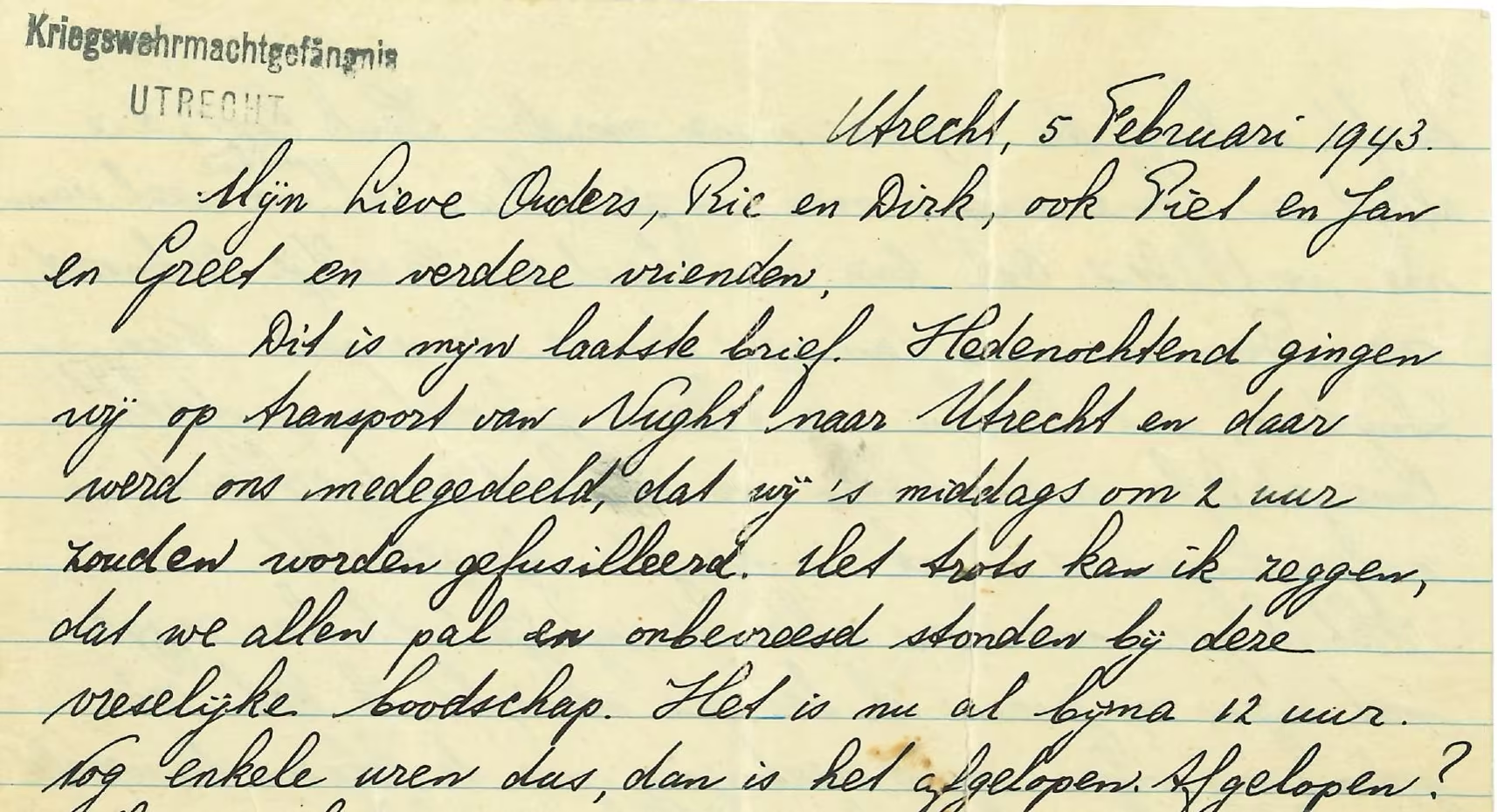
The book ‘Niet buigen, niet bukken’ is a tribute to the illegal resistance newspaper Het Parool
Every February 5, the Democracy and Media Foundation (SDM) commemorates all *Het Parool* employees who lost their lives during World War II. How do you keep history alive when those involved can no longer tell their own stories? The book*Niet buigen, niet bukken*(Don’t Bow, Don’t Bend), written by Jos Sinnema and designed by Christa Jesse on behalf of SDM, is an invitation to remember and learn from the past.
Below is the first chapter of*Don’t Bend, Don’t Bow*. Download the digital version of the entire book here.
Call for Former Employees

Alida vividly remembers her first tentative steps into a life of illegality. “I’ll never forget that first day when I was supposed to go to Amsterdam-West with the courier. I don’t remember exactly how everything went, but an air raid siren that lasted for hours threw everything into disarray. The courier and I spent the whole afternoon chasing after each other, unable to find one another. To me, still unfamiliar with the tricks of the trade, she seemed to have vanished into thin air. The next day, things became clearer, and it wasn’t until the day after that I really got the hang of it.”
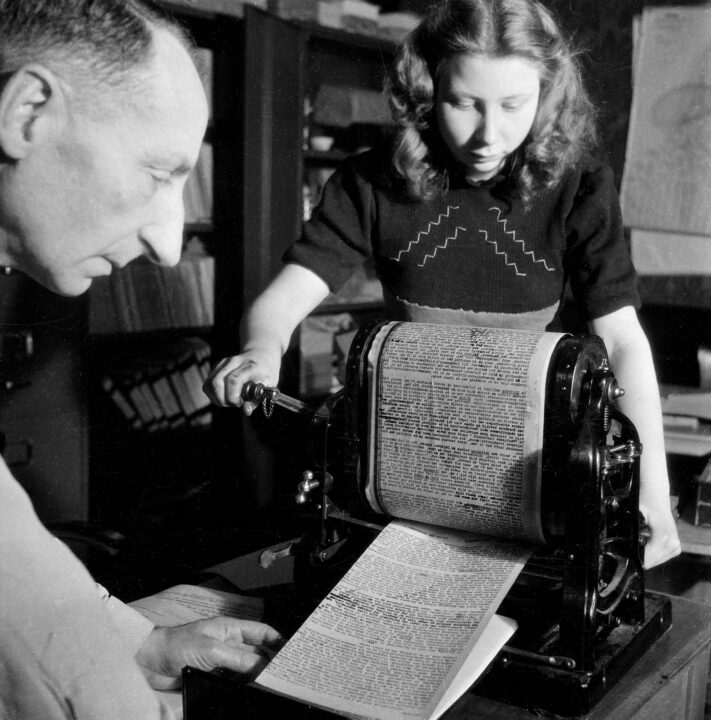
At a stencil shop in Amsterdam-West, Alida typed stencils for the daily news bulletin that *Het Parool* published alongside its weekly print edition. “The first few days, I didn’t really have a clue how things worked there. All I knew was that I had to type up two sets of stencils somewhere. One set was taken to a place I didn’t know, and the other I had to deliver and help run through the machine. Well, that running through the machine. I’ve never seen such an archaic machine. I had to feed the sheets of paper into it one by one, which of course took ages. We could only run it very slowly, and if the copies were too wet, they’d smudge; if they were too dry, they were immediately unreadable. The whole process required effort, patience, but above all, soap—because it was impossible to ink the machine without getting your hands, from your fingernails to your wrists, cinder-black. I had to take some of the finished copies to Amsterdam-Noord. And that’s how it went for a few months. Our spirits were high as we typed and turned the pages. We sang one tractor song after another and teased each other as loudly as we could.’
Stenciling
In the 1930s and 1940s, stenciling was the most common method for quickly reproducing printed material. It was used, among others, in offices, by organizations, and by journalists. The technique is a form of transfer printing. The stencil consists of a material that allows ink to pass through, covered with a non-permeable wax layer. By removing the wax layer with a typewriter or a special pen, a stencil is created that allows ink to pass through. That stencil is stretched over a drum filled with ink. You make prints by rotating the drum. Blank paper is fed into the stencil machine on one side, and it comes out on the other side 
Alida wasn’t the only one who responded to the call in *Het Parool*. Nearly 2,500 former employees of the resistance newspaper did so. Their responses have been preserved at the NIOD in Amsterdam. The vast majority of them went on to become distributors of Het Parool after September 1944. The number of *Het Parool* staff members grew rapidly during that time. The southern part of the Netherlands had been liberated, events were unfolding rapidly, and in the occupied territories there was an insatiable hunger for news. At the same time, more people dared to take on the distribution work with the prospect of a German defeat. Unlike the distributors from Het Parool’s early days—who, like the printers, were sometimes still directly involved with the newspaper through the editorial staff—there was no direct connection between these distributors and the editorial staff. These people, in particular, felt the need to share more with the editorial staff than just what they had done for the illegal Parool and when. They sat down, wrote a letter, and recounted their memories in detail. Together, they provide a unique insight into the ways in which people became involved with the resistance newspaper, their motivations, the difficulties they had to overcome, and the dangers they faced.
The vast majority of responses to the call for submissions date from June 1945. So soon after the liberation, memories of the resistance were still very fresh. Some descriptions are so vivid and vivid that, as a reader, you can imagine yourself right there. The letters also convey the feelings of the immediate aftermath of liberation. Conflicting emotions vie for dominance. There is great joy over the liberation, but at the same time, there is still a great deal of uncertainty and fear regarding the fate of many resistance fighters who were arrested and taken away by the Germans. A brother of Wim Rooijackers writes that Wim was arrested in August 1944. “To this day, we have not received any word from him.” Wim was the chief distributor of *Het Parool* in Heerlen and active in a pilot network. It would not be until October 1946 that the Red Cross was able to inform his family that Wim had been executed by firing squad on September 5, 1944, at the Vught concentration camp.
Some letter writers found their homes in ruins upon returning from hiding. Willem Baarschers, a leaflet distributor from Doorn who narrowly escaped arrest by the Germans, writes: “My household goods were confiscated, and three-quarters of them were hauled away. The Germans cut out all the windows on the back of the house.”
Many former Parool employees are hopeful for a better future, but there is also disappointment. “Above all, I cannot approve of the general attitude toward NSB members,” says Bram Storm, a printer from Utrecht, speaking from the heart. “The Dutch people are responding with acts of revenge and retaliation on par with those of the German SS.”
Just before the liberation, the Germans raided the home of Johannes Smeur—who had been mimeographing and distributing the Het Parool news bulletin in Utrecht—with a force of fourteen men. Johannes was warned in time and managed to escape. Instead, his wife Maria was taken away, leaving their four young children behind. She spent ten days in solitary confinement at the prison on Wolvenplein and was interrogated several times. Thanks to the German surrender on May 5, 1945, she was released. Johannes wrote in his October 1945 letter to *Het Parool*: “My wife still hasn’t fully recovered from that trying time and her stay in prison. I regret having to write in such a somber tone now, as I had imagined the course of events to be quite different.’
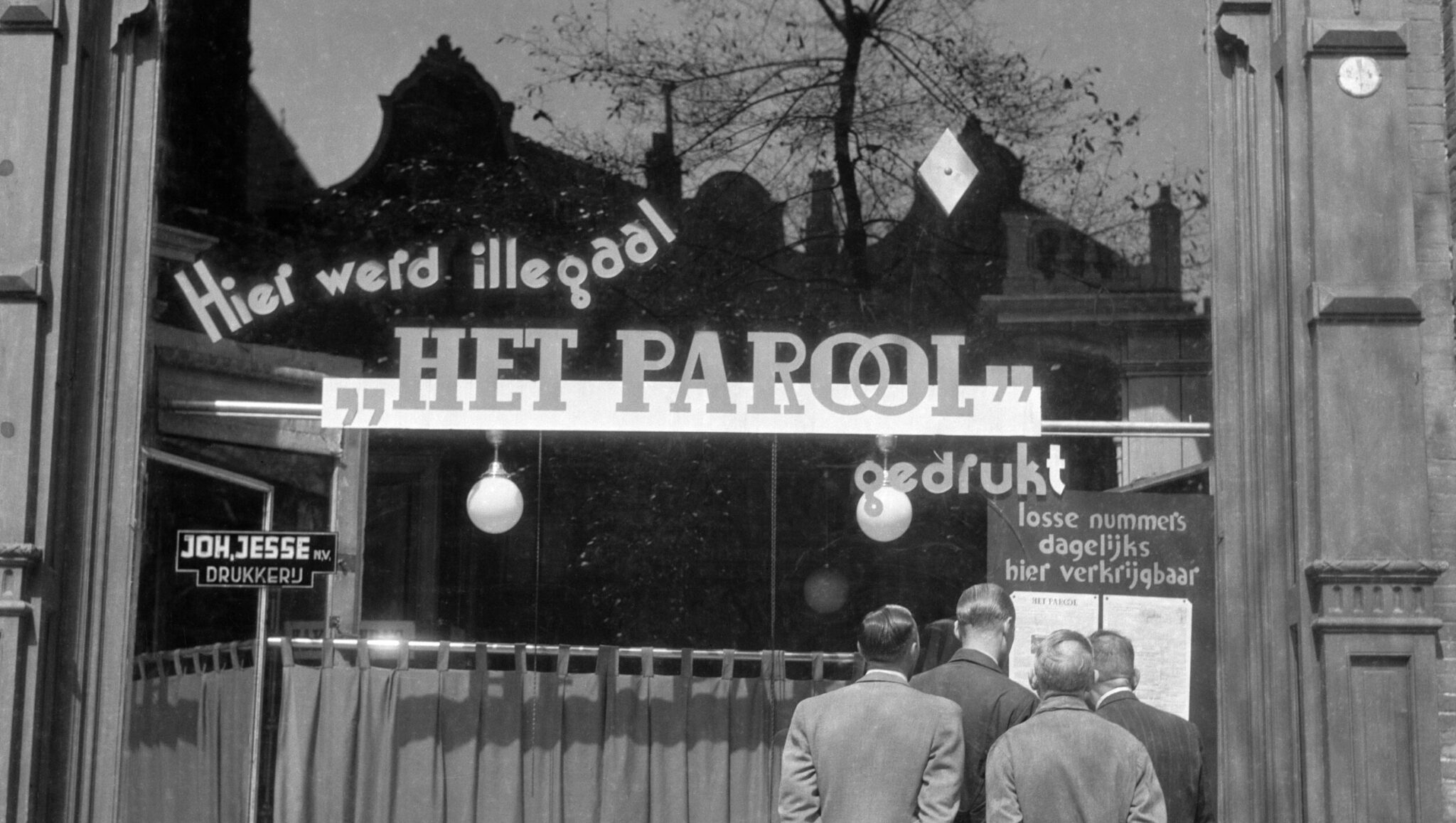
Unlike during the occupation, *Het Parool* was not distributed in Limburg, Zeeland, and Drenthe after the liberation. In these provinces, many former Parool employees certainly missed the call to come forward. It is likely, therefore, that there were considerably more former Parool employees than the nearly 2,500 who responded. The responses also show that many former employees were not at all eager to respond. Many only came forward after the second, repeated call. “It is with some hesitation that I am doing this,” writes distributor Jan Overbeeke from Rotterdam, “because these were precisely the kinds of activities you never talked about. You felt like you had done much less than others.” Student Johannes Pielage, who distributed *Het Parool* in Amsterdam, felt the same way: the little he had done wasn’t worth mentioning. He also believes that it does not benefit the rebuilding of the country if a distinction continues to be made between members of the resistance and those who were not.
Nico Bregman from Amsterdam writes: “My only job for *Het Parool* during the Occupation was to distribute 22 copies of the mimeographed newsletter. I took over this task from a friend (Jo Vis from Amstelveen) after he was arrested and dragged off to a concentration camp. Don’t forget him—but do forget me!’
Nico adds that he also took over from Jo the care of thirteen people in hiding. He provided them with ration coupons, while he himself sheltered three Jewish people in hiding in his own home for a year. Nevertheless, he writes: “I’m still ashamed that I did so little; that’s why I’ve been hesitating.”
In addition to great modesty, the letters convey a sense of gratitude, as well as nostalgia for the sense of community that many experienced while living in hiding. “Every evening, I distributed underground literature with great enthusiasm,” said 69-year-old Elizabeth Hagenbeek-van der Velde of Amsterdam. “I had thirteen regular customers who eagerly awaited my arrival every evening. They, in turn, made sure the materials were passed on. For me, it was a joyful experience, a rewarding feeling, because I was able to do something to give the Germans a hard time.”
Alida Holter, with whom this chapter began, moved from Amsterdam-West to a new stencil station in Oost in November 1944. The station was housed in a small clubhouse that almost no one ever visited. It had a much better stencil machine than the one in West, and there was a small coal stove. That little stove became, as it were, “a part of ourselves,” she writes. Together with the two other women at the stencil station, Alida would prepare full meals on this stove in between tasks. Alida: “In a sense, we worked in East with a certain regularity, which was only disrupted by the tearing of stencils (there was a time when I typed four or five a day), the machine malfunctioning, or the copy not arriving, which my female colleague and I took turns fetching. Typing was my job. The three of us did the stenciling together—that is, when one of us took one batch away, another would take over.”
“You always felt like you were doing much less than others”
Even during the Hunger Winter, when there was hardly any food left, virtually no coal, and no electricity, the women carried on working undeterred. “Although we sometimes nearly came to blows during those nerve-wracking times of oil lamps and hunger, I can still say that we worked together exceptionally well. And that’s why I also look back fondly on my time in the underground. So much so that I’m tempted to join Weerwolf just to work illegally again.” Weerwolf was a Nazi resistance movement tasked with attacking the Allies from behind as they conquered Germany. “Too bad that’s not my principle,” Alida jokes in her letter.
“What really made a deep impression on me were Mother Nature’s whims. It was truly incredible that, during this very period, we had the heaviest rainfall in years, weeks of storms in the fall, and a thick layer of snow in the winter. Phew, those wet coats. One day I’d wear one, and the next I’d wear a dry one. The next day I’d borrow one from my sister, because all of mine were still soaked. And then waiting at the agreed-upon spot for the manuscript, out in the snow, whether or not I’d slipped and slid on my bike or slipped and fallen on foot. Still, I look back on it with a touch of nostalgia. At least we had a goal.”
Former *Het Parool* employees take particular pride in the fact that they worked right under the noses of the occupying forces or NSB members. In Friesland, the Central Union of Transport Workers handled the distribution and shipping of *Het Parool* starting in 1942. From the union office in Leeuwarden, four insiders forwarded the newspapers to contacts throughout the province for further distribution, as packages from the union. “Later, for a while, we stopped receiving packages and had to take care of the reproduction ourselves,” writes union director Freerk Heijtinga. The arrival of NSB members in the back hallway of the union office was no reason to stop mimeographing, even though the NSB members had to be in the front hallway regularly to make phone calls. “We just kept working to avoid arousing suspicion.”
From the moment it was published, Klaas Kenter delivered the resistance newspaper “into the lion’s den.” On July 5, 1945, *Het Parool* devoted an article to his letter and paraphrased it as follows: “At the Kleine-Gartmanplantsoen Detention Center I in Amsterdam, where I work as a guard, I always smuggled enough copies inside so that the political prisoners could read them. Of course, that couldn’t happen in the cell. I would first hide these people behind the cooking stove or in the guards’ restroom, where they could read the news from *Het Parool* undisturbed. When I was working in the barracks where many female political prisoners were housed, I had to use a different method. I would hide in the restroom and pass on the main foreign news and family messages to the prisoners who came nearby to get water.’
Distributor Arie Prins from Rotterdam describes a problem that other former *Parool* employees also faced. He wanted to do his part for the underground movement. “But how could I break into that shadowy world? Eventually, after a long search and a lot of trial and error, I managed to track down a lead distributor, so to speak. Closer to home than I had suspected. That lead distributor was my own brother-in-law, and that’s how I got the first five—and later twenty—copies.”
In The Hague, Wilhelmus Erwich found himself drawn into the resistance almost naturally. He found the first stack of newspapers in his mailbox, along with a note asking him to distribute them among trustworthy people. If he did, the unknown sender would provide a new shipment every day. “Apparently, refusal wasn’t an option,” he writes, “because from that moment on, I promptly received the news every day. It would have been a piece of cake for me to discover the identity of my client. I would have only had to stand by the mailbox at the usual time to catch him red-handed. However, I had long since decided that this was fine the way it was. The fewer people who knew about this kind of work, the better.”
Seven months later, that caution was no longer necessary. “On Liberation Day, the well-known and striking image of the lion breaking its chains appeared in my immediate neighbor’s window. And so the mystery of my client was solved. It was Mr. A. Goud, who owns a printing shop on Hemsterhuisstraat.”
Several former Het Parool employees emphasize that distributing Het Parool was a family affair. Willem Eshuis of Rotterdam, his wife, and their two daughters distributed 25 copies of Het Parool, 25 of De Vrije Pers, and 25 of Trouw every day. The newspapers were delivered to their home every evening. “Then we’d quickly head out to distribute them. My wife would put them in her bag. My daughters—one 15 and the other 13 at the time—would often tuck one or two into the sleeves of their coats, and I’d put some in my inside pocket.”
Two people in hiding also helped out at Jacob Meijer’s home in Amsterdam-Zuid. Upstairs, Jaap van Meekren, a Jewish man who would go on to become a well-known journalist and TV presenter after the war, typed the stencil for the daily *Paroolbulletin* for Amstelveen. Meijer: “I received the copy from headquarters, and the typed stencil was then taken by a female courier to Amstelveen, where it was printed.” Barend Waldhaus, who was in hiding with Jacob to avoid being sent to Germany as a forced laborer, ventured out onto the street to help with the delivery. Jacob is grateful to his two people in hiding. But what bothers him is that he hasn’t heard a single word of praise in any newspaper for the thousands of housewives who cared for people in hiding. “That is why I would also like to express my heartfelt thanks to my wife, who had the courage to take in two people in hiding for over a year and a half while caring for two small children. It was the housewives who, under the most difficult circumstances, had to ensure that food was on the table and who had to endure and listen to their ups and downs from early in the morning until late at night. A salute to these brave warriors,” he concludes.
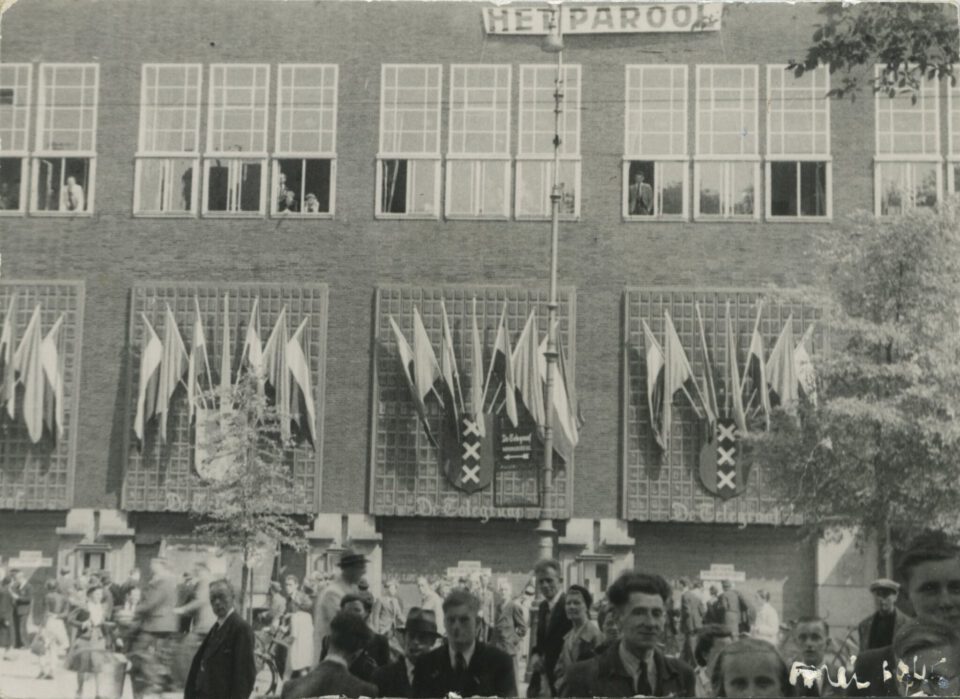
The letter-writers express particular praise for their colleagues in the resistance, whom they sometimes view with admiration. Geus Osephius-van Zwam of Rotterdam recalls how a delivery woman fainted when she came to pick up a new edition of the newspaper from her. It was a cold day, in the middle of the Hunger Winter. “Luckily, I had some hot porridge. After she finished it, she said, ‘Now I’ll hurry back, because work comes first.’ She was a brave little woman and never afraid.”
Several “dissident” Dutch people lived in the neighborhood around Geus, which meant she had to be extra careful. Still, according to her, those were also joyful days. “Because you knew that, on the one hand, you were thwarting the Germans, and on the other hand, through the often cheerful reports in *Het Parool*, you were helping people get through those difficult times. Even though things often moved too slowly for us, we knew the Germans would eventually be defeated.”
The parents who write about their children’s role in distributing the illegal *Parool* are particularly effusive—and anything but modest. Wilhelmina Schouten-Balke of Amsterdam is the only one among the nearly 2,500 letter writers to include a photo—of her then 13-year-old son, Jan. “Did you know that this boy was the youngest courier?” she begins her letter. “I’d really like to tell you how he faithfully delivered twenty copies every time, come rain or shine.” Even when his father was in hiding, Jan kept going. “As if his life depended on it. And if it wasn’t safe enough, he’d go out two or three times.”
“Everything was done on foot,” writes Johannes Koëter of Baarn about the daily distribution of 250 to 350 bulletins by his teenage daughters, To and Janneke. “They trudged past German checkpoints and through barbed-wire fences to the outskirts of the village. Through snow, rain, and malnourished, they would return home exhausted time and time again during the winter of 1944–1945.”
Cornelis Leefkens, a native of Amsterdam, took *Het Parool* with him to Uithoorn, Vrouwenakker, and Nieuwveen, where he picked up milk from farmers. “They were quite keen on it. Sometimes you really had to keep a sharp eye out along the Amstel. My son, who was 14 at the time, also often delivered several cartons to an address on the Weesperzijde, which was quite a thrill for a boy his age. More than once he came home saying, ‘There were Grüne (Germans) on the bridge again, but I walked right past them with a straight face.’ You might say that was irresponsible. However, I knew I could trust him completely.”
High school students played a major role in the distribution of *Het Parool*. Hans Schippers, who earned his HBS diploma in 1940 at the age of 17, became a key driving force behind the distribution by high school students, starting in Amsterdam. “At Hans’s request, I organized the coordination among the high schools and distributed *Het Parool* through this system,” writes Johannes Peelen. “I then helped him ship *Het Parool* to other cities.”
The role that schoolchildren played in spreading the news grew rapidly after the introduction of the mandatory Arbeitseinsatz in May 1943. All men between the ages of 18 and 35 were required to report for forced labor in Germany. Tens of thousands of men went into hiding. From that moment on, it was dangerous for them to be on the streets; they could be arrested at any checkpoint. Because the Germans kept raising the age limit for the Arbeitseinsatz, this applied to an ever-increasing number of men. Students and women took the place of distributors who had stopped for this reason.
In Baarn, the then 16-year-old Wobien van Rossem was overjoyed when she was asked to distribute the news bulletin for *Het Parool*. “How often had I longed to do something—even if it was just a small part—that went against the Germans? Now I had the chance, and on December 11, 1944, I walked to the address I’d been given for the first time. At first it was a little scary, especially when I walked down the street one time and saw a few Germans standing right near the house where I was supposed to go. But little by little, that fear faded.” Wobien spent hours every day distributing the bulletins in Baarn and the surrounding area. “In the freezing cold and through wind and rain, I walked the same route every day. If I couldn’t do it, my little sister would, and for the last two months, we always went together.”
Only a single former *Parool* employee says she was never afraid. According to 73-year-old Aagtje Meulenkamp-Luijt, distributing the bulletin gave her nothing but great satisfaction. “I’ve always had unshakable faith in the triumph of justice. I’ve never known fear or anxiety. But I was cautious. I never went out in the evening, but I did go out as often as possible at different times.
Sometimes I’d head out my door to the left, other times to the right; sometimes I’d start with this block, other times with another.”
Many letter writers say they themselves “never experienced any trouble.” They weren’t caught and made it through the war unscathed. But the danger was very real and ever-present. Especially for those who were arrested, the fear could be suffocating.
“When they shouted and threatened me during interrogations, I pretended to faint.”
“I am no hero,” writes Marga Wierdels-Monsma, “and I am very sensitive to physical pain.” Marga was a member of the Parool group in The Hague that was rounded up in early 1942. In her prison cell, her greatest fear was that she would reveal the names of Parool staff members or readers. “When they shouted and threatened me during interrogations, I feigned fainting spells. This came all the more easily to me since I have a heart condition and systematically went without food during my entire stay at Scheveningen. Half a slice of bread a day; my cellmates knew exactly what to do with my portion. In the end, the fainting spells were real.”
Marga was released from the Scheveningen prison after the German prison doctor gave her less than a week to live. He declared her Haft- und Lagerunfähig (unfit for detention). “That’s how I got through it without getting anyone into trouble. But I’m certain I wouldn’t have been able to remain silent in the face of abuse.” Two of Marga’s *Parool* colleagues, Herman Meinardi and Wibo Lans, stood trial in what would become known as the “first *Parool* trial” and were executed by firing squad on February 5, 1943, along with eleven other *Parool* staff members at the Leusderheide near Soesterberg.
Members of the Parool Group in Zaandam also faced extreme pressure. Thirty-year-old Piet Teeling recalls how anxious he was after the arrest of Martinus Arends, less than half an hour after Arends had received a thousand copies of *Het Parool* for further distribution. During a transfer, Arends tried to escape. To no avail. “The abuse he suffered at that time nearly cost him his life. His kidneys were beaten to a pulp. We didn’t know whether Arends would be forced by the Nazis’ interrogation methods to reveal the name of the person from whom he had received the newspapers, W. Boot. To be on the safe side, he went into hiding with me. Until reports reached us from secret sources that he was holding up exceptionally well and hadn’t talked.” Arends ended up in the concentration camps at Vught, Sachsenhausen, and Buchenwald. “Miraculously, he made it through,” Teeling writes with relief. “Just the other day, he wrote to his wife and children that he hopes to reach Zaandam in a few weeks.”
No matter how they contributed to *Het Parool* or how small they often considered their own role to be, together these people kept the resistance newspaper going. Together, they ensured that *Het Parool* could grow into a national resistance newspaper distributed throughout all eleven provinces at the time. The first issue of Pieter ’t Hoen’s Newsletter, the precursor to Het Parool, appeared as early as July 25, 1940. This makes the newspaper one of the earliest of the approximately 1,300 different illegal publications that appeared in occupied Netherlands. Most of these publications were mimeographed or even simply typed. They often existed for only a short time and were published only locally or regionally. Only a handful of publications managed to grow into leading national resistance newspapers that every Dutch person knew, at least by name. In addition to the socialist *Het Parool*, these included the Reformed *Trouw*, which had the largest circulation; the communist *De Waarheid*; the Protestant and later socialist *Vrij Nederland*, and *Je Maintiendrai*, which built on the ideas of the Dutch Union—banned by the Germans in December 1941—and advocated for a society free of religious and political divisions.
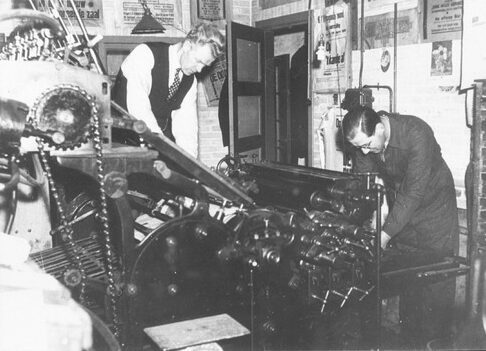
On August 11, 1941, *Het Parool* became the first resistance newspaper to appear in print. Its circulation spread like wildfire, and the print run quickly increased: from 500 copies of Pieter ’t Hoen’s Nieuwsbrief in July 1940 to 31,000 copies of Het Parool in September 1944, when the Allies liberated the southern part of the Netherlands. Although the resistance newspaper was distributed primarily in North Holland, South Holland, and Utrecht, readers throughout the Netherlands eagerly awaited it. “It started long before I even received my copies myself,” said distributor Geus Osephius-van Zwam. “The most trustworthy readers who lived closest by would come and ask, ‘Hey Geus, is there anything yet?’ By that time, the people at my house—including some people in hiding—would sneak up to the window to see if something was approaching on a bicycle.”
Het Parool served as a counterbalance to the “propaganda press” censored by the Germans and shed light on the occupiers’ true intentions. The newspaper offered readers moral support, showed them the proper attitude toward the occupiers, and made clear the ways in which they could resist. Het Parool also kept spirits high during the darkest and most hopeless moments of the war. “How welcome was the clatter of the mailbox announcing the arrival of my little Parool papers,” said distributor Wim Bosman. “First, I’d read the news myself, and then I’d hurry off to deliver the daily ‘Parool boost’ to a dozen other eager residents of The Hague.” Mrs. Buddingh, who took the newspaper from Bussum to the hospital and to patients being cared for at home, writes: “If everything was safe, I’d read it aloud and pass it on. There were those who saw a bleak future, often because of their illness and the isolation it caused. Then I’d start: ‘Listen, Het Parool says…’ I know that, thanks to that, many people fortunately began to see things differently again.”
The fact that *Het Parool* was a widely read resistance newspaper is thanks to its editorial staff. Unlike many other resistance newspapers, its staff consisted of seasoned journalists who possessed extensive expertise, an excellent network, and a way with words. The articles were written in a lively style, the arguments were clear, and the analysis of the news was incisive. The editorial staff’s covert access to uncensored information from a Swiss news agency in Amsterdam gave it a unique informational advantage. The newspaper was professionally designed and printed, which reinforced the impression that the news was reliable.
Another factor that was just as important to its success was that the newspaper was soon able to rely on an extensive network of distributors. Members of the Arbeiders Jeugd Centrale (AJC)—the youth movement of the SDAP, the predecessor of the PvdA—were happy to take on this work. SDAP chairman Koos Vorrink joined the editorial staff and traveled throughout the country to recruit AJC and SDAP members to help with distribution.
It was also important that the Parool organization showed resilience. The organization was able to adapt to the ever-changing circumstances. For example, when everyone was required to turn in their radios in May 1943. In response, listening posts and mimeograph groups were gradually set up throughout the country to summarize the news from Radio Oranje and the BBC in a daily mimeographed news bulletin. This bulletin appeared alongside the weekly printed newspaper, which contained more in-depth articles and commentary. The listening posts and mimeograph groups really took off starting in September 1944, when the southern part of the Netherlands had been liberated, events were unfolding rapidly, and the hunger for news in the occupied territories was almost insatiable.
On several occasions, the Germans dealt severe blows to the *Het Parool* organization. For example, the arrest of a large group of Parool staff members in early 1942 and the execution of thirteen of them on February 5, 1943, hit Het Parool hard. But even this did not spell the end of the newspaper. Each time, the organization managed to recover. The staff members who had escaped unscathed learned from the mistakes they had made and from observing how the Germans operated.
The following chapters show how *Het Parool* evolved during the occupation—from a small, underground newspaper conceived and written by a single man to a well-oiled resistance organization and an influential resistance newspaper with a nationwide reach.
“How welcome was the clatter of the mailbox announcing the arrival of my copies of *Het Parool*”
This is a preview of the first chapter of the book *Niet buigen niet bukken*, about the history of the underground newspaper *Het Parool*. Download the digital version of the entire book here .
News and articles