Letter to the informateur on behalf of the Dutch media sector
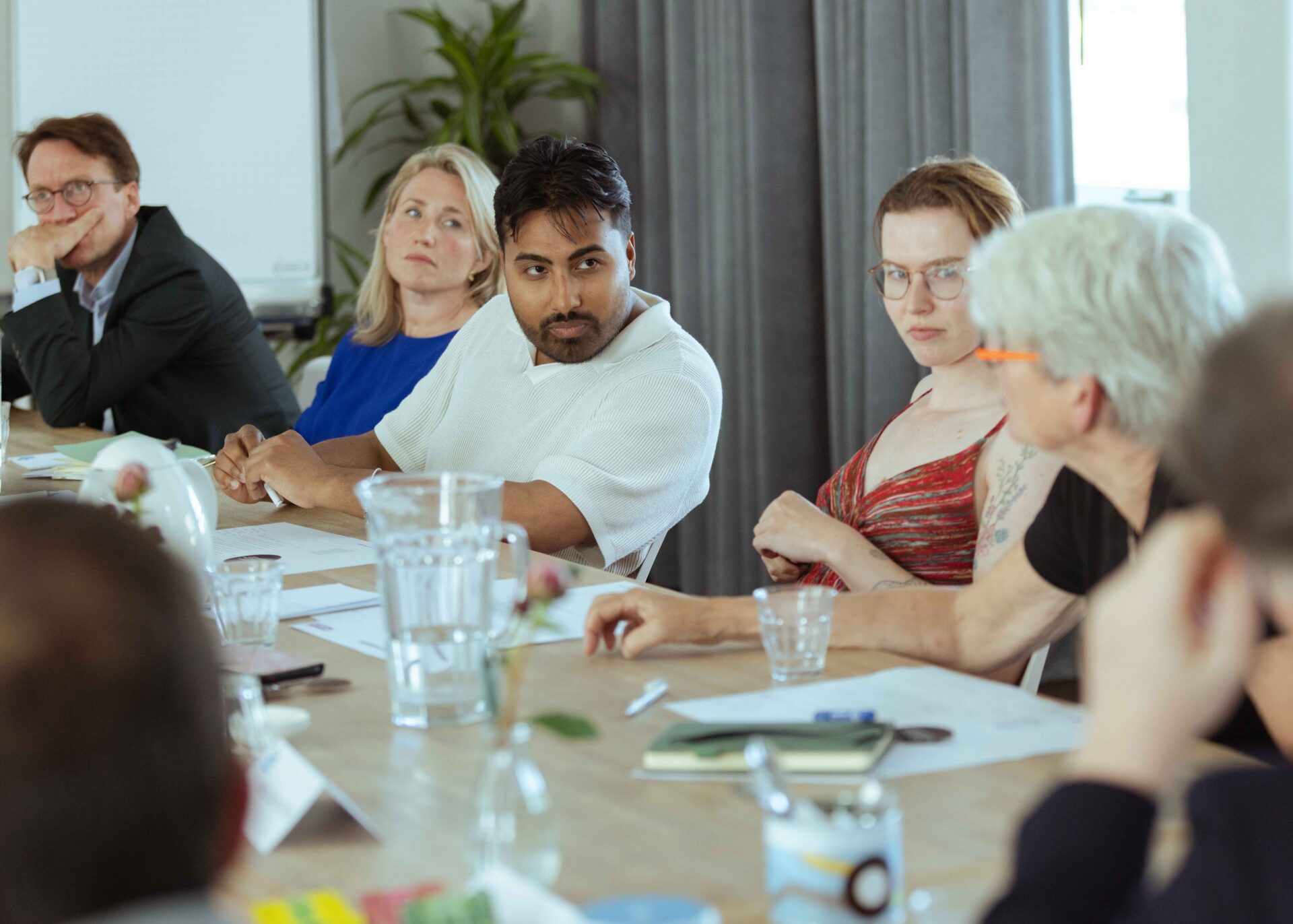
Photo: Remko de Waal, ANP
Amsterdam, November 18, 2025
Dear Mr. Buma,
For the first time in history, all major Dutch media outlets—both public and private—are joining forces to approach the informateur. There is an urgent reason for this: our society is losing its grip on a truth-seeking and pluralistic information system due to the dominant role of global tech companies. This poses a serious threat not only to democratic resilience but also to the Netherlands’ strategic autonomy and, consequently, its security.
The provision of news and information to citizens is increasingly falling into the hands of global tech companies with commercial objectives. Democratic values are not part of that. An effective response to this development requires innovation and creativity on our part, but also a fresh approach to media policy in the Netherlands—one that does not primarily protect current structures, but rather strengthens the future media landscape—and, with it, our democracy.
Since “security” is one of the key items on your agenda for the coming period, we urge you to also make the security of information systems a priority in the upcoming coalition talks.
Dutch Media Under Pressure
While social media has already radically changed our information landscape, generative AI applications are now setting in motion the next, even more fundamental transformation. Citizens searching for information online are increasingly getting their answers from an AI-based search engine, chatbot, or virtual assistant, rather than from journalistic or other editorially vetted sources. Currently, one in nine young adults uses generative AI to obtain information.
AI offers an unprecedented array of possibilities that media organizations will embrace. But this technology also carries significant risks. The responses generated by AI applications are often unreliable, frequently one-sided, and difficult to verify. The systems are susceptible to manipulation and, moreover, often produce inaccurate or fabricated information that cannot be refuted. The underlying algorithms and the origin of the training data remain largely a black box. AI companies do not accept accountability for the content or results of their output. This has major consequences for the quality, reliability, and diversity of the information that reaches people.
Because users receive their information directly from AI applications, tech companies keep users on their own platforms. At the same time, these companies use our journalistic content without our permission to train their models. Together, this causes news organizations to lose reach and revenue on a massive scale. This not only weakens our media landscape but also, in turn, the quality of the information on which AI models are trained. That quality deteriorates as fewer independent, human-produced journalistic pieces remain. This risks creating a downward spiral that undermines the quality of public information and, consequently, the democratic resilience of our society. The less room there is for journalistic reporting, the less we know about what is really happening in our country and around the world.
This is no longer a typical competition between an old and a new sector. The question now is: Which digital infrastructure for providing information to society will ultimately prevail? Will it be the algorithms of American and Chinese tech giants—over which we have no control and which accept no responsibility? Or will we build an innovative Dutch digital ecosystem driven by democratic values, where AI can flourish but media organizations retain the freedom to provide citizens with reliable information?
Decisive Policy Is Needed
We are ready to join forces to harness our innovative strength to create a robust, independent, and attractive digital media landscape. To achieve this, we need a forward-thinking political vision and decisive policies from our government.
- Integrated Media and Technology Policy
- The government must take an integrated approach to media and technology, preferably under the responsibility of a single (coordinating) government official. After all, media production, presentation, and consumption are driven by technology; the two policy areas can no longer be separated. Moreover, this integrated policy approach is necessary to strengthen the Dutch media as a whole.
- There is significant investment in AI, and the Netherlands wants to be a leader in this field, but the news industry and its crucial role in the AI ecosystem are not currently an integral part of those plans. Explicitly involve the media sector. And ensure that policy enables the media to contribute to new AI technology.
- Furthermore, an integrated approach requires integrated oversight—especially where there is unfair competition between local and global players—aimed at safeguarding the diversity, independence, and accountability of the information provided to Dutch citizens, regardless of the platform.
- Swift and robust implementation of European legislation
The European Union has taken steps to protect European democracies against the concentration of power by “Big Tech.” In the interest of a resilient democratic society and an innovative and pluralistic European technology and media sector, it is essential that the Netherlands take a stronger stance on the European stage.
- In the Netherlands, European legislation—such as the European AI Act—must be implemented swiftly and rigorously, in a way that effectively protects our media sector from global tech giants. In this regard, transparency on the part of tech companies and measures to combat illegal scraping are of crucial importance. This will compel these companies to operate within democratic frameworks and in accordance with the rule of law, while ensuring that the media sector, in turn, retains the safeguards necessary to innovate.
At the initiative of the Democracy and Media Foundation, the entire Dutch media sector—both private and public—is calling on policymakers to include a decisive response in the next coalition agreement. Waiting until the next cabinet term will be too late.
Sincerely,
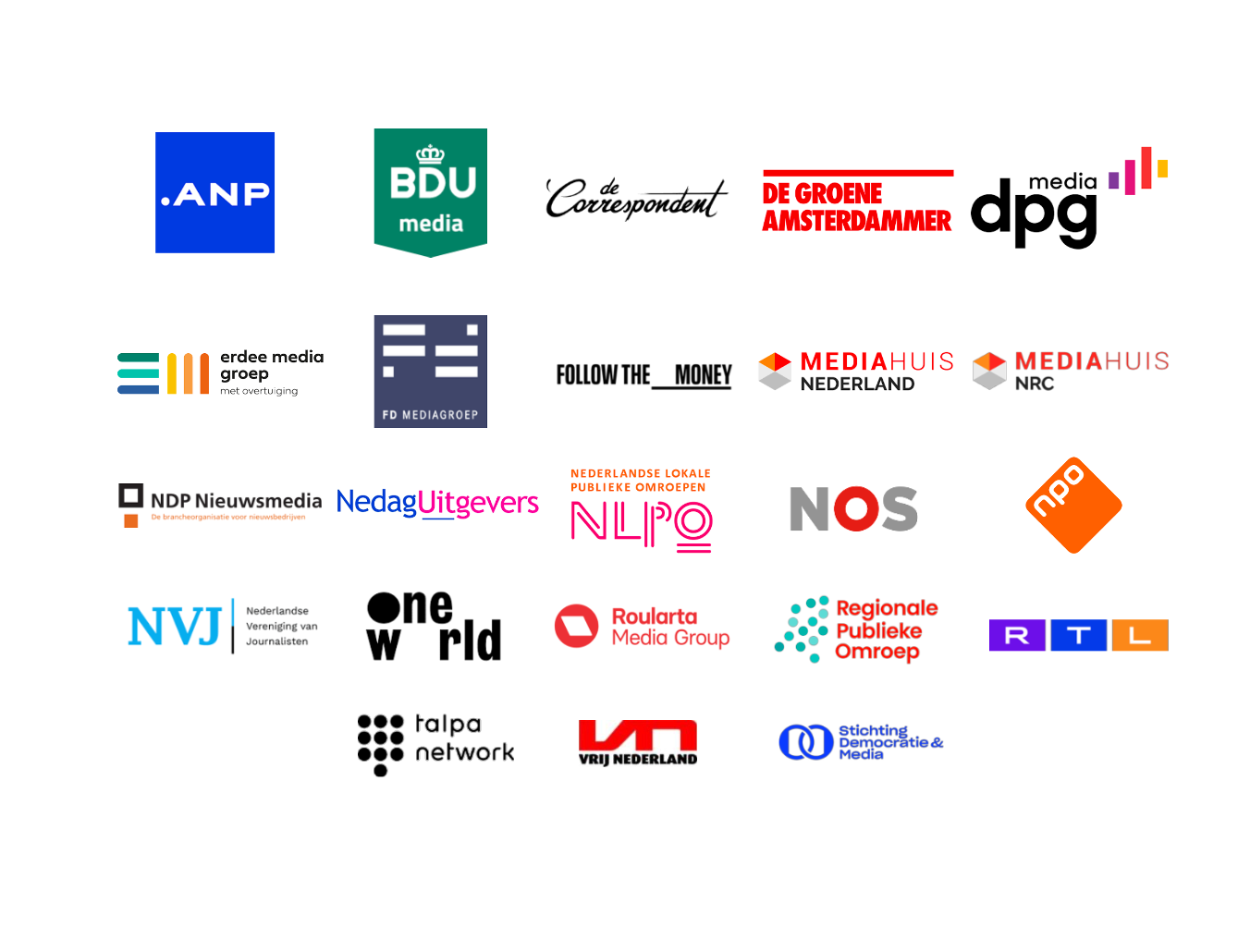
ANP, Martha Riemsma (Director)
BDUmedia, Ton Roskam (Managing Director)
De Correspondent, Sabine Bijleveld (Director)
De Groene Amsterdammer, Pieter Elshout (Director)
Erdee Media Group, Cornell Heutink (Director)
DPG Media, Erik Roddenhof (CEO)
FD Mediagroep, Eugenie van Wiechen (Managing Director)
Follow the Money, Jan-Willem Sanders (Director)
Mediahuis Netherlands, Rien van Beemen (CEO)
Mediahuis NRC, Dominic Stas (CEO)
NDP News Media, Herman Wolswinkel (Director)
Nedag Publishers/Nederlands Dagblad, Vincenza La Porta (Director and Publisher)
NLPO, Eric Horvath (Executive Director)
NOS, Renate Eringa (Executive Director)
NPO, Lucien Brouwer (Chairman of the Board)
NVJ, Thomas Bruning (General Secretary)
OneWorld, John Olivieira-Siere (publisher)
Roularta Media Netherlands, Marjolein Denekamp (CEO)
RPO, Jan Müller (Managing Director)
RTL Netherlands, Sven Sauvé (CEO)
Talpa Network, Joost Brakel (CEO)
Vrij Nederland, Sander Heijne (editor-in-chief)
Democracy and Media Foundation, Nienke Venema (Executive Director)
News and articles