Marjan Slob: ‘Merely repeating isolated, unsubstantiated opinions is, democratically speaking, lazy and impoverished’
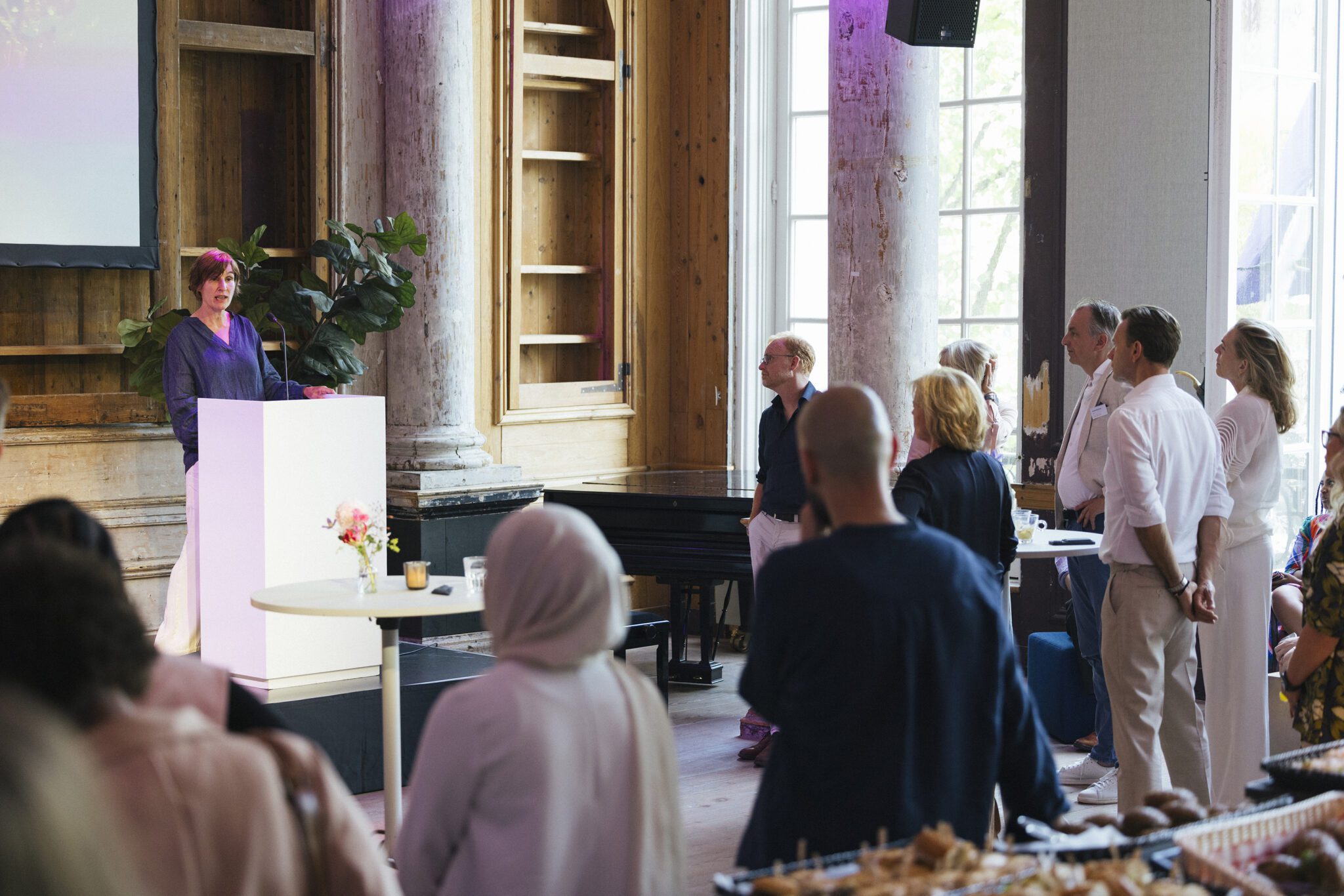
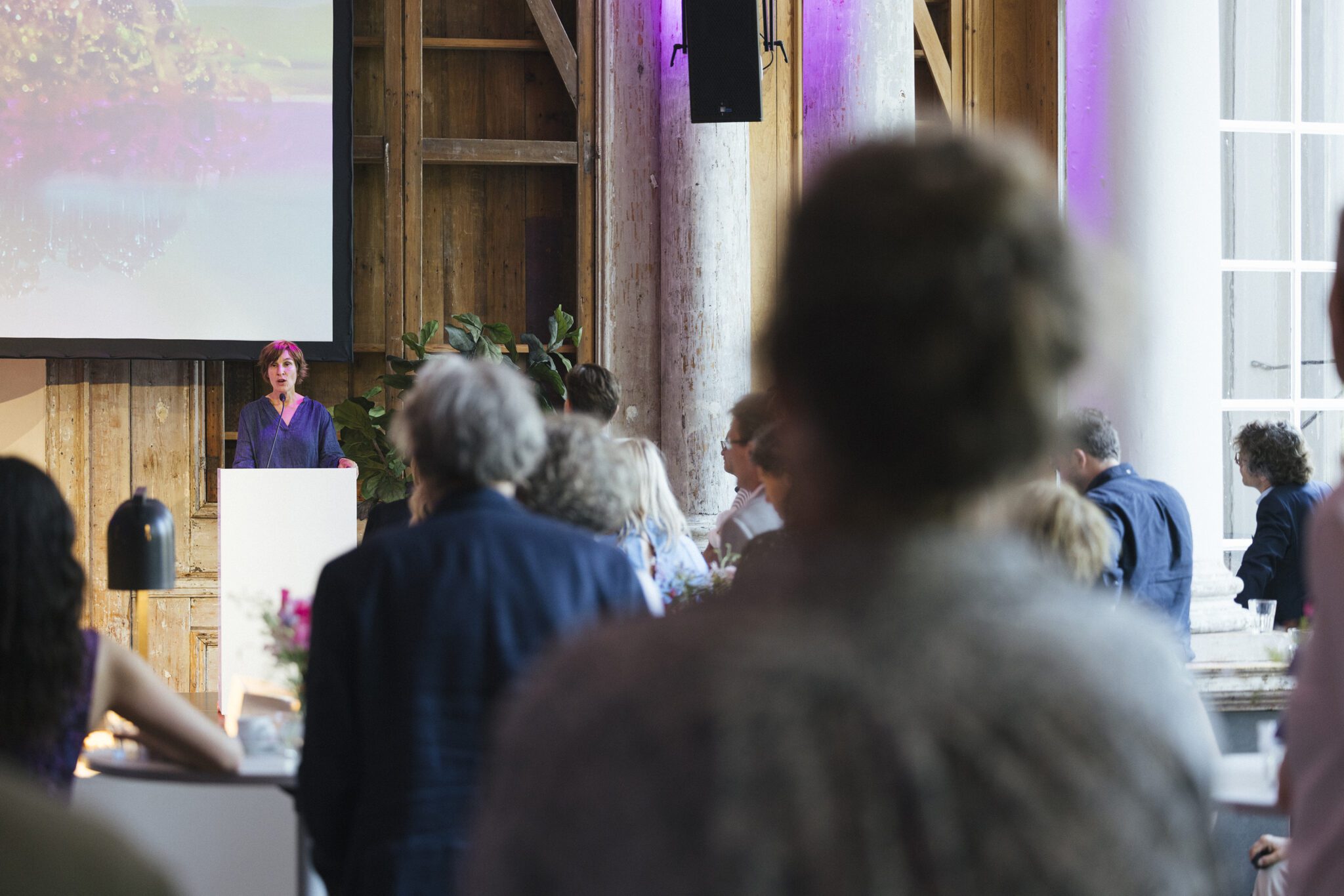
At the second edition of Media for Democracy, philosopher Marjan Slob addressed more than a hundred prominent figures from the Dutch journalism community. You can watch and read her full speech here.
Text: Marjan Slob
When a downpour hits the tropical habitat of the red fire ant, the ants in a colony quickly form a sort of ball. They interlock their legs, with eggs and young ants in the center and adult ants at the edges. Air bubbles become trapped among the ants in this intertwined cluster. As soon as the flood wave reaches the colony and the water lifts the ants, the colony becomes a sort of raft that floats on the churning water thanks to those bubbles.
How long the tidal wave will last, and where it will take them, is uncertain. For the ants, there is no goal; there is only a situation: being swept along by that current. Hope does not come from outside, nor from the prospect of a destination. Hope comes from solidarity. From holding on to one another.
To me, we’re like those ants. We may think we set our own course, but in light of the political storms raging across the world, our influence is minimal. In these frightening circumstances, we must rely above all on a sense of community. A democratic mindset serves as our lifeline in this regard. That way of holding on to one another and keeping our relationships with each other somewhat orderly and fair—even when we don’t know one another—is by far the most powerful tool we have to influence our fate to some extent.
Of course, there’s a lot wrong with our democracy (a term that I, like Sean Illing, would like to interpret broadly). In addition to structural flaws, personal lust for power, excessive wealth disparities, incompetence, and blatant indifference are popping the air bubbles between our legs, and that seriously undermines the raft’s buoyancy. If we want to maintain, modernize, and repair that democracy, we must hold each other accountable and examine and scrutinize the narratives we use to connect with one another. That is an important task of journalism.
Democratic bubble
This is my view of our situation. Here, I want to further explore what this view means for today’s question – how can journalism protect a shared reality?
First and foremost, this image teaches me that, outside of such a raft, a meaningful existence is inconceivable for us as social beings. The implications of this are enormous. It means, for example, that we cannot observe what human rafts look like from a distance. Such a neutral, “objective” outsider’s perspective does not exist; it is a fantasy. Contrary to the romanticized image that journalists themselves sometimes hold, journalists are always part of a community, and they piece together the best possible picture of the situation in which the raft finds itself using the language of the group. From the inside. Without actually being able to survey that situation, since they’re on the raft themselves.
You could say: journalists, too, operate from the bubble of their raft. As a philosopher, though, I don’t really have much use for that buzzword “bubble.” To me, it’s a vague term, because everyone lives in a bubble! How else would you imagine it? Outside a bubble, there’s simply no meaning. The question is rather: what counts as a good bubble?
For me, a good bubble is a democratic bubble. A good bubble is one in which a small personal world is expanded into a truly public space. In a public space, it’s normal to realize that you’re sharing your space with others who may be quite different from you, but who are nonetheless vital to your survival. In such a “bubble,” the values and interests of others resonate, and you relate them to your own. Expanding your own perspective in this way is neither utopian nor impossible. It is intrinsic to democracy, and we’ve been practicing it quite well for some time now. That’s how we’ve managed to stay afloat for a good two centuries.
That image of the ant raft also implies something about the status of truth—yet another word that is central to discussions about journalism. Here, where we are now, a newspaper was printed that, shortly after the war, was briefly the largest in the Netherlands, and was simply called *De Waarheid* (The Truth). In my view, “truth” is still an important, guiding concept. But it is a human construct, a word that functions within a specific public sphere—and has no meaning outside of it. The consequence: scientists and journalists can examine claims to truth both within and outside their communities. But no one is in a position to pass a truly independent judgment on them. The Truth no longer exists.
The Role of Journalism
Okay. So what exactly is the role or function of the media on a raft like this? Narrowing it down to today’s question: How can journalism support democracy? I think: by, as a journalist, abandoning that quasi-objective stance and working from the understanding that you’re informing your community—as best you can—about the situation the raft finds itself in, and about what’s happening on the raft itself. And I believe there are two ways to do that.
First: by reporting based on facts, and thoroughly verifying those facts. At first glance, this might seem to contradict my earlier statement that the truth is unknowable to us. Indeed, definitive and universal truth is beyond our reach. But we can certainly detect falsehoods. These are claims that do not align with known facts and well-established assumptions. In other words: we cannot know what the truth is. But we can determine what is false—what constitutes lies or inaccuracies. And in practice, that is more than enough to still be able to make a very meaningful and powerful distinction between news and fake news. So, for a journalist to serve democracy means investigating whether claims to truth made by members of the community are sound and hold up to scrutiny.
The second way to keep that community well-informed is by fostering connection. Connection creates the air bubbles that keep the raft afloat. In journalistic terms, connecting means providing context. Making stories more cohesive. Linking statements, values, and interests together. So it’s not just about informing citizens that the cabinet has fallen, but also asking: Why did Wilders bring down the cabinet? Why didn’t Yeşilgöz initially exclude the PVV, and why is she doing so now? Contextualization brings together disparate opinions and facts and elevates information to insight. And insight is the rudder with which we can still steer that raft of ours, at least to some extent.
So, as I reflect on the role of journalists in a democracy, I arrive at two well-known, classic activities: fact-checking and interpreting facts. That is what defines a journalist for me. And that is precisely what distinguishes it from non-journalistic content in the media—from content intended to entertain, sell, distract, or influence. Not all media outlets practice journalism, and not all sections in “journalistic” media are journalistic. There’s nothing wrong with that in and of itself. The confusion arises, however, because “the media” and “journalism” are often used interchangeably in practice—a confusion that is also reflected in the name of the organizing foundation, Stichting Democratie en Media. I believe we need to stake a clearer claim to journalism, because by linking the word “media” so loosely to journalism, we allow non-journalistic media to usurp the authority that traditional “news media” have painstakingly built up since the seventeenth century. These other media outlets thereby confer upon themselves a prestige they do not possess. And in the meantime, they undermine the authority of journalism.
Hot air and empty rhetoric
In short: fact-checking and interpreting facts are the essence of journalism. And professional journalists should realize that their work is never “true” in the sense of being completely objective, because they cannot step outside their own linguistic and value community.
But there is yet another way in which journalistic descriptions are not neutral: those descriptions themselves are also facts within society. Members of the community do care about the reports from their journalists. They give them serious thought. So your descriptions of the situation on the raft also change the situation on the raft. As far as I’m concerned, this places a considerable responsibility on the shoulders of journalists. The question at hand is: how does journalism itself contribute to the atmosphere on the raft?
I know it might come across as an easy shot when I say this, but personally, I’m growing increasingly fed up with all those superficial polls, surveys, and vox pops. Even after the recent fall of the cabinet, the polls and street interviews were once again everywhere, and I think the media really needs to take a serious look at the damage they’re causing and the message they’re sending. It’s not just that, as a journalist, you turn those opinions and polls into facts that influence the actual voting behavior of viewers and listeners. It’s also that, in my view, chasing quick opinions is detrimental to the democratic spirit that journalism is supposed to nurture and foster.
From a democratic perspective, polls and street interviews are toxic. This is because they do not address people as citizens, but rather as a kind of “policy consumer.” They are asked to offer an isolated opinion, which they are under no obligation to substantiate or relate to the values and interests of others—or even to their own other interests and values. Some people want to both drive faster on the A27 and preserve Amelisweerd, and journalists let them get away with it. Yet opinions in the public sphere should, in fact, be interconnected—that’s what creates that connection and that cohesion. All too often, journalism provides a platform for narrow-minded and fragmented slogans. From a democratic standpoint, journalists thereby encourage an irresponsible attitude.
Give “the people on the street” a voice. But don’t adopt the air of some kind of cultural anthropologist who simply records what this strange tribe is thinking now. Treat these people as the fellow citizens they are and give their opinions a place right there in the shared public space. Link their slogans to concrete actions. So ask a PVV supporter: “Why do you think Wilders will succeed in stopping migrants next time?” Ask for an explanation from people who believe that more money for the defense industry will help Ukraine. Have protesters blocking traffic explain why they’re suing Shell in court but consider illegal behavior justified in their own case.
There’s no need to be sarcastic. Be curious. Just ask open-ended questions about the scope of people’s viewpoints. That’s the fair and respectful thing to do, because if you let people get away with empty rhetoric and sound bites, you’re essentially using them as filler for your segment or story.

Just to be clear: I’m not advocating that we ignore the public sentiment in the country. That sentiment is also a fact. But merely repeating isolated, irresponsible—in the sense of unsubstantiated—opinions is, from a democratic perspective, lazy and shallow. Moreover, it serves the interests of those in power, because it teaches them which political strings to pull to retain power. This kind of journalism undermines the raft’s buoyancy and only causes the air bubbles between our feet to burst even more.
So when you ask people for their opinions, don’t let them bask in their fifteen seconds of fame—take them seriously as citizens and ask follow-up questions. That means you, as a journalist, have your work cut out for you, because to ask good questions, you’ll need to have a clear understanding of how things are connected. But that’s how you strengthen those connections, and that’s how journalism serves democracy. It’s wonderful work—and fortunately, you don’t need to use any big, flashy philosophical terms to do it.
–
Thanks to zestien:negen for editing and subtitling the video. You can also watch the contributions to Media for Democracy by Sean Illing and Ernestine Comvalius here.
News and articles