Maxim Februari: ‘Let’s talk about current affairs’
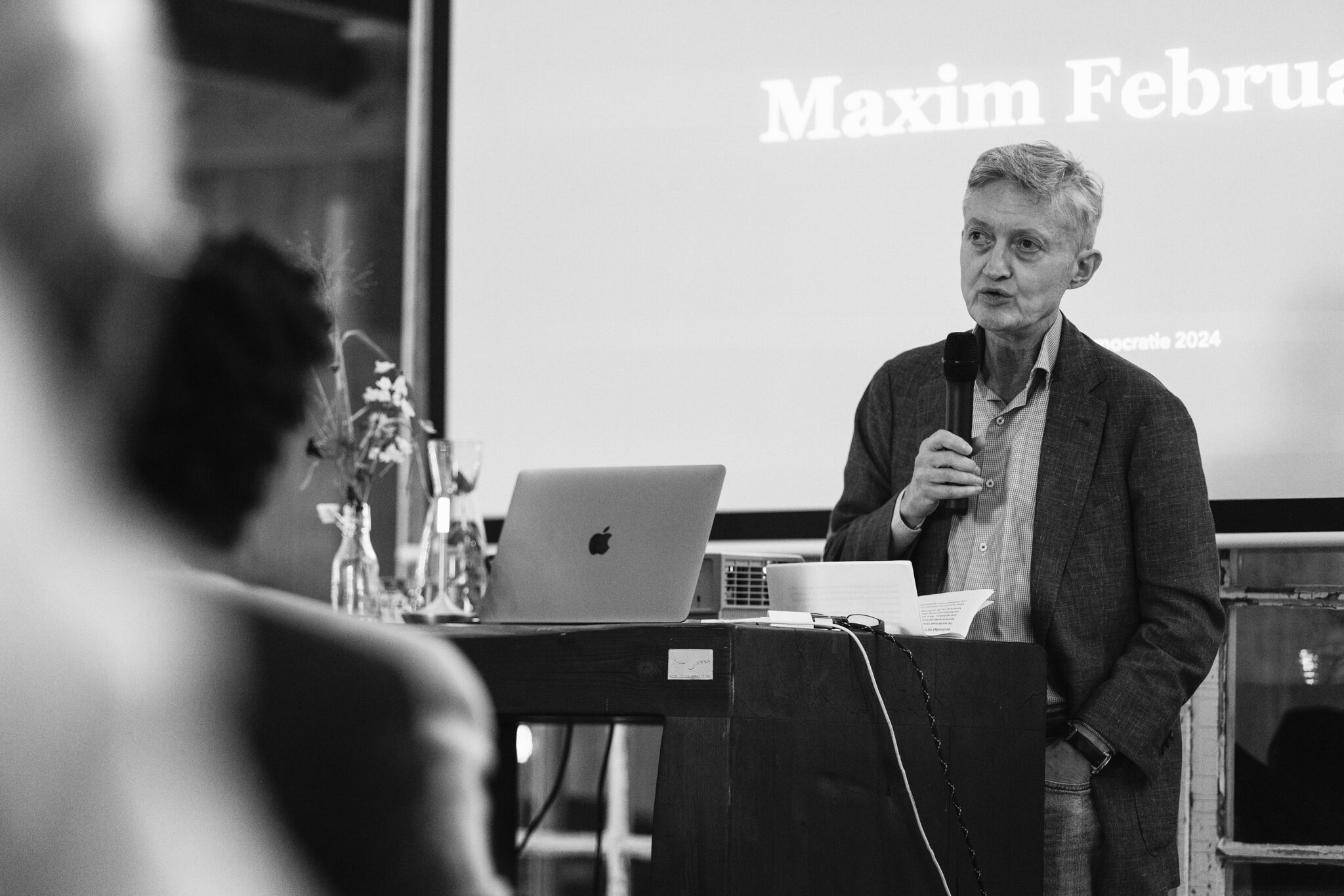
On the longest day of the year, one hundred influential figures from the Dutch media gathered at the “Media for Democracy” event, organized by SDM. One of the speakers was legal philosopher Maxim Februari, who later put his remarks in writing.
Text: Maxim Februari
The week after the SDM Event, I woke up with a thought about the word “woke.” It’s nice when people are awake, I thought, but you’d wish they were even more awake, even more fully awake, and that the “woke” people wouldn’t remain so drowsily stuck in the emancipation themes of the twentieth century, but would finally arrive in the digitized twenty-first century.
I’ve been thinking about that whole waking up thing for a while now. This year, I’m reading *A Winter Evening in Ufa* by the Danish author Inger Christensen with a Viennese translators’ collective. The play dates from 1986, and its core message is (1) that the world will be flooded as a result of climate change and (2) that society will be programmed and encoded by computers. The play appears to have been written in 2024 or 2029, but is actually nearly forty years old.
We’ve all known this for a long time—we’ve known about climate change for a century, and about digitalization for half a century—but we just don’t act on it. Only when it’s too late does it make the news, and only then do the newsrooms wake up.
This is not a criticism of serious journalism; it is a description of its role and position. As a writer, you can see problems coming from a distance, but as long as something isn’t news, it isn’t news.
We gathered on June 21, 2024, to take a look at the chaos of the moment, because it’s finally making the news: everything I’m saying about it here I learned neatly from the press this summer.
Democracy
First news item: democracy is falling out of favor. In June, the NOS once again summarized recent studies showing that young people no longer trust democracy. Worldwide, one-third of young people see some merit in a dictatorship; in Europe, only half still believe in democracy. In their view, democracy moves too slowly and lacks the necessary decisiveness in times of crisis. Too many problems, too little power: young people are calling for a more radical approach. Not just on the right, but on the left as well.
And young people are not alone in this. A few years ago, as a columnist, I collected statements from policymakers who said that, due to time pressures and crises, they would prefer to bypass existing legislative procedures. When I studied the phenomenon more closely, I came across the term “government by emergency”—governing by invoking emergencies. Condoleezza Rice, former U.S. Secretary of State, has called it “authoritarian envy,” authoritarian envy—the desire for the dictator’s decisiveness. A few years ago, that still sounded like a reproach on her part; now, authoritarian, dictatorial envy is at the very heart of society. Democracy is more or less passé.
The SDM brought the profession together to explore how journalism can continue to play its indispensable role —as the invitation states—in democracy. And, yes, that is an urgent issue, but if journalism wants to reclaim its position in democracy, it must do so with the understanding that democracy itself is shifting and that journalism, therefore, is inevitably shifting along with it. It will have to figure out in what entirely new and uncertain situation it must now play its indispensable role.
More on that role later. First, the rule of law.
Rule of Law
Until recently, under the old system, the rule of law served as a check on democracy: one could invoke legal principles to counterbalance majority decisions. But the rule of law no longer automatically plays that role either.
The second news story I came across recently was about the report from the State Commission on the Rule of Law. Not only has the public lost its full faith in democracy, but there is also a crisis in the state—a crisis of trust between citizens and an unapproachable government. The State Commission hopes for a recovery, but I have my doubts.
In March, *De Groene* published an interview with—now—Prime Minister Schoof. “The rule of law and democracy are always subject to change,” he says in the interview. We know from the Prime Minister that he himself has regularly circumvented the rule of law by invoking security— government by emergency —and he reinforces that approach in this interview in De Groene.
The rule of law is changing, he says: “For example, when it comes to counterterrorism legislation, we view privacy and freedom differently than we did twenty years ago.” In other words, we view legal protections differently than we did twenty years ago. Security takes precedence over the rule of law and is thereby radically changing it.
In July, presidential candidate Donald Trump suddenly named J.D. Vance as his running mate. Vance has little regard for democracy and the rule of law. I read in the newspapers that he entered politics through his mentor Peter Thiel, and we’ve known Peter Thiel for some time now for his sweeping technocratic ambitions.
“‘I no longer believe that democracy and freedom can coexist,’ Thiel wrote as early as 2009 in a libertarian magazine. Since then, he has combined his libertarian rhetoric with seemingly contradictory investments in companies that help the government monitor its citizens and enemies. The surveillance company Palantir is the largest of these, with the Pentagon and the Israeli Ministry of Defense as clients.” (Michael Persson, VK, July 20, 2024)
This is what technological innovation brings us: not democracy, not the rule of law, but surveillance and data control. Not politics and justice, but control and coercion. “I could go on at length about this,” I said on June 21 at the meeting of the Democracy and Media Foundation, “but I’m gradually starting to become the village idiot with my musings on this subject. In journalism, nobody cares at all, so I’ll stop talking about it; I’ll just wait until it’s too late and it makes the news.”
A few weeks later, in July 2024, with the rise of J.D. Vance, it seems to have become cautious news after all. Journalistic commentary points to the link between Silicon Valley and the far-right political agenda: technological innovation must proceed unhindered, and trust is no longer placed in politics, but in coercion or even violence. War is declared on anything that might possibly happen, which justifies the curtailment of civil liberties.
This is not an aberration; this is what the21st century brings in terms of the decline of democracy and the rule of law.
A researcher at Sogeti’s New Technology Research Institute writes in *De Volkskrant* that technological progress “is often associated with progressive values,” but that technology “can in fact be used to promote regressive and potentially dangerous political agendas.”
It is a sign of the naivety of the past ten or twenty years that innovation has, in fact, always been associated with progress. It is a sign of today’s naivety that the potential danger is perceived only on the radical right.
Authoritarian jealousy is popping up everywhere. The rule of law, which is supposed to keep democracy on track, is under immense pressure—from an indifferent government, from an authoritarian and jealous government, from activism on both the right and the left, from the technocratic lobby, and from dictatorial foreign powers, which are currently infiltrating our systems through the switchboards.
So, well, the role of journalism in a democratic constitutional state. If you look at it from a distance, you see that the press is losing its authority due to precisely the same causes that are causing the system as a whole to falter. The declining authority of journalism is a symptom, an indicator of the faltering of democracy and the rule of law. All decisions—as well as all flows of information—now bypass the institutions.
Information
It’s time to talk about this. Our intellectual culture is fixated on history: in all the book supplements and debates, you’re considered a great intellectual if you can recount the20th century. But we’re no longer in the20th century; we’ve arrived in the21st. We have computers.
It is troubling that political analyses by prominent opinion leaders still pay no attention whatsoever to these new developments, and it is even more troubling that we continue to take those analyses seriously. Wake up—there’s a lot going on in Silicon Valley.
All sorts of things are happening, and the good news is: it’s also incredibly interesting. Intellectually, at least, there’s a lot of excitement to be found in the current situation, in which everything is changing—government, the law, power dynamics, and the way information is created and shared.
For journalism, it’s a challenging situation because it must not only report on this situation, but also report from within it—and is influenced by it. That influence extends far beyond the impact ChatGPT has on employment. The uncertainty, the systemic changes, and the accompanying turmoil affecting all institutions are also impacting the news media. It’s hard to imagine how they can regain their authority.
A good first step might be to acknowledge that, these days, information is widely shared online outside the traditional media. Because of the widespread online availability of information, the20th-century questions about the nature of science and knowledge have made their way into the public sphere in the21st century.
Literally.
During the meeting on June 21, we watched a short video in which Roel Maalderink spoke with passersby on the street: when asked about their trust in journalism, they expressed interesting and valid doubts about the reliability of information. These doubts stemmed directly and unchanged from science itself; they are also precisely the doubts from which journalism derives its raison d’être.
In the video, several passersby expressed concern that we don’t know what we should know. And that’s true. Knowledge is indeed sometimes obscured, due to vested interests and secrets. You can laugh derisively at the passersby’s conspiracy theories, or you can simply admit that they’re right.
Throughout the last century, Bruno Latour tirelessly highlighted the interests that lie behind scientific research. Science historian Robert Proctor once gave a well-known example of obstruction in such research: the study of how tectonic plates work was halted for a long time because the government had classified the data as secret due to undersea warfare.
It’s simply this: we don’t know everything we want or need to know.
Thanks to the spread of information, you now hear critical questions about this topic in street interviews. That’s great. It seems to me to be a good starting point for conversations between passersby and journalists.
Agenda
There are other things we do know, though—and those are precisely the things we don’t need to know. In the video, you heard a woman grumbling that she had no interest in stories about boys who want to become girls and vice versa. She wanted to know other things. She didn’t know what they were, because “you guys don’t tell us.” This woman has my sympathy.
I’m more familiar with the transgender issue than most, and I’ve followed the media coverage of it with the same bewilderment as some members of the general public. I recently saw the transgender issue mentioned again as one of the “major issues of our time.” Yet I truly believe that the housing crisis, the subsidence in the Netherlands, and the threat of war are, without exception, more pressing national issues. The topic of transgender issues doesn’t interest this woman, and she’s absolutely right about that.
Over the past ten years, serious journalism has used transgender people as clickbait. And as “dictator bait.” Look how open-minded we are! Yeah, fantastic—congratulations. The problem is that the public’s justified annoyance over this ends up being directed at transgender people. I don’t appreciate the press for that.
Lately, I’ve also been having a concerning number of conversations with people on the left side of the political spectrum who, on the one hand, are dogmatically sensitive about the space between “trans” and “people” —because trans people are deeply, deeply, deeply hurt when you write “trans people”—and who, at the same time, glorify violence (“nonviolent resistance doesn’t work”) and dismiss the rule of law with a dismissive gesture (“I don’t believe in the rule of law”).
I think things have gotten out of balance here, and the same goes for the media’s coverage of modern-leftist views on the protection of legal rights.
Knowledge Production
What do we know, and what don’t we know? What is this really about, and what isn’t? That’s what people on the street are wondering.
The press often tends, out of sheer self-indulgence, to present itself as the guardian of the facts. But, as you know, there are no facts. Like data, they are manufactured; they are the result of selection, choices, definitions, and so on. What do we want to know, and what don’t we? Journalism selects events and turns them into news stories.
What’s new in the21st century is that knowledge and facts are generated by data systems. From the perspective of search engines and sensors, we are data, and the processing of our behavior comes with a claim to knowledge: Facebook knows you better than your significant other. J.D. Vance’s mentor, Peter Thiele, claims—just like the World Economic Forum—that with the help of data and a dashboard, he will soon be able to solve all the world’s problems.
This new issue goes far, far, far beyond concerns about fake news and job losses caused by ChatGPT. This political issue centers on the fundamental claim made by technology companies that they provide knowledge—knowledge that can be used to govern the world. This undermines not only democracy and the rule of law, but also the institutions that work with information and knowledge, such as journalism.
And on this point, too, journalism will have to take a stand: in uncertain times, what else (and more) can an editorial team offer besides a dashboard?
Personally, I think the advantage of journalism lies in the fact that it doesn’t plow through humanity on the street like a data system—it can engage with them. The fact that newsrooms are made up of people—who listen, talk, breathe, and can be moved—will prove to be a huge advantage. Provided, of course, that the newsrooms actually engage in that conversation.
The public’s interest in the philosophy of knowledge presents opportunities here: I think you can harness this shared fascination with what we do and do not (or cannot) know to create a truly21st-century form of journalism. This new, precarious situation requires us to agree once again on what we consider reliable knowledge and whom we trust to investigate it.
In conclusion
What should you do first thing on Monday morning? That’s what you want to know—and that’s what the whole of the Netherlands wants to know. It’s a sign of authoritarian envy: Tell us what to do, great leader. Unfortunately, I don’t know what you should do first thing on Monday morning.
I do realize that we need to wake up to the reality of this21st century, in which, as the prime minister says, democracy and the rule of law are “undergoing change.”
This is an edited version of the remarks Maxim Februari delivered at the Media for Democracy event on June 21, 2024.
News and articles