Rob Wijnberg: ‘If we fill newspaper after newspaper with stories about how divided we are as a society, then we will indeed become divided’
Rob Wijnberg (41) founded De Correspondent ten years ago as a “remedy for the issues of the day.” SDM has been a mission-driven shareholder from the very beginning. Armed with a manifesto and a team of correspondents, Wijnberg opted for a radically different approach to news. What can we learn from his pioneering work in journalism? And how relevant is his mission statement a decade later? A conversation about the state and future of journalism based on De Correspondent’s ten guiding principles.
Text: Martha Riemsma
Let’s start with your main theme:
1. We are your antidote to the issues of the day.
How would you describe today’s delusion?
“It’s no different than it was ten years ago. It’s about excessive attention being paid to news that doesn’t deserve that attention at all, because it has barely any impact. I don’t think such news shouldn’t exist, but there are a number of inherent shortcomings in the nature of news that have a problematic side effect. For example, it’s always about what’s happening today, but rarely about what happens every day. Yet the latter is far more influential.”
Today’s public outrage manifests itself differently than it did ten years ago due to the influence of social media. Social media fuels the issues of the day by amplifying news that provokes outrage in exchange for clicks and attention. On top of that, more and more political actors are making it a strategy to keep that “outrage machine” constantly running so they can profit from it themselves. Trump is a prime example of this, but it’s happening here in the Netherlands as well. A remedy for the frenzy of the day is therefore more relevant than ever, in new ways.’
What does that medicine look like to you?
“We focus on topics that aren’t easily captured in a simple narrative, but that are nonetheless very influential. I often refer to ‘the news’ as ‘the weather,’ while we try to cover ‘the climate.’ The trick is to find non-mainstream topics that still affect our entire lives. Rutger Bregman describes this well in his latest book, *Moral Ambition*: strong topics have in common that they are “broad, underreported, and solvable.” Take container shipping, for example; 90 percent of our goods come from a shipping container. There’s a hidden world behind that with a significant dark side. That’s exactly the kind of topic for us.’
2. We are completely ad-free; we do not sell your attention to advertisers.
How is De Correspondent doing? Are you profitable?
“Things are going well; yes, we’re profitable. We experienced a brief dip in membership (now 65,000). That was due to a price increase, and like many other media outlets, we saw a decline after the pandemic. That cost us about 5,000 members. But now we’re stable and have cautiously started to see an upward trend again. I’d certainly like to see that growth accelerate so we can make larger investments in quality once more.”
Is your membership model a future-proof business model?
“I believe journalism should be paid for by readers. I still think the best model is this: you pay for journalism so it doesn’t disappear behind a paywall. That’s the model we use, and it’s also the model used by a newspaper like The Guardian, where readers can voluntarily contribute financially. “Pay to keep it free,” you could call it. That way, quality journalism remains available to society, but isn’t dependent on advertisers or subsidies. I think there are enough people who recognize the value of strong journalism.”
The Guardian is owned by a wealthy fund and has been running endless losses for the past ten years, right?
“They’ve been turning a profit for several years now. It works. It’s simply a good model. But I also believe in strong public broadcasting. Actually, for future-proof, high-quality journalism, a mix of The Guardian, the BBC, and a few good German newspapers would be ideal.”
3. We combat stereotypes, prejudices, and fear-mongering; we do not participate in news coverage intended to shock rather than inform.
You actively speak out against these kinds of tactics for generating media attention and clicks. If you want to remain visible as a news outlet, can you really do without them?
“Well, these days that’s a kind of constant, ironic, contradictory struggle. The question is, can you do without it? Right now, the answer is ‘no.’ But that doesn’t mean you can’t think about how the answer to that might one day be ‘yes.’ And that’s important, because an excessive focus on conflicts creates a gap between actual reality and media reality. That media reality is an exaggeration of extremes and polarities. And yet all studies show that views are actually converging. The consensus on climate change, for example, is incredibly broad—much broader than social media algorithms would have us believe. The problem is that media reality sometimes actually becomes reality. If we fill newspaper after newspaper with stories about how we’re pitted against one another in society, then we will indeed end up pitted against one another.”
Will major news sites ever start to think ‘‘Who cares about those clicks? Let’s take it a little easier’”?
“I see a number of major threats in this regard. Our public debate is increasingly being co-opted and privatized by ever-larger media conglomerates, such as DPG Media and Mediahuis. They view journalism more and more as “content” and less as something that should serve the public interest. At the end of the day, they’re primarily concerned with what journalism brings in.”
In addition—and this is threat number two—Elon Musk and Mark Zuckerberg are essentially single-handedly determining which topics gain traction in the public debate. The algorithms of the major Silicon Valley platforms have, to an insane degree, come to dictate the news agenda. Media companies are gaining a better understanding of how these algorithms amplify their news and are directing part of their efforts toward that. But these platforms have absolutely no concept of journalism as a valuable component of a democracy.
The development of AI will lead to even greater privatization of the news. After all, AI is essentially nothing more than the outright appropriation of all the world’s information by private companies. We can only speculate about the consequences of this. And then, to top it all off, public broadcasting is also under fire in the current political climate.’
You’re painting a bleak picture. Is there anything we can do to counter that?
“It’s something I’ve been racking my brain over: for a large part of humanity, those massive platforms are the internet. If you’re not visible there, you don’t amount to much. But on the other hand, it’s not an unstoppable trend. We can make decisions, just as we do with regard to AI. I see it as my mission for the next ten years to get the conversation going on this topic.”
Are journalists sufficiently aware of these developments?
“There is a substantial school of thought—albeit a shrinking one—that pretends journalism is not part of the power dynamics in society. It is the journalistic mindset that says: we merely record what happens; we do not influence what happens. As if they were merely a conduit. Yet the influence of media reality on actual reality is significant. The last five elections have been won by the party that “owned” the dominant theme in the news, such as migration (PVV) and nitrogen (BBB). It comes down to the realization that, as a journalist, you make news big or small—and that makes a difference.”
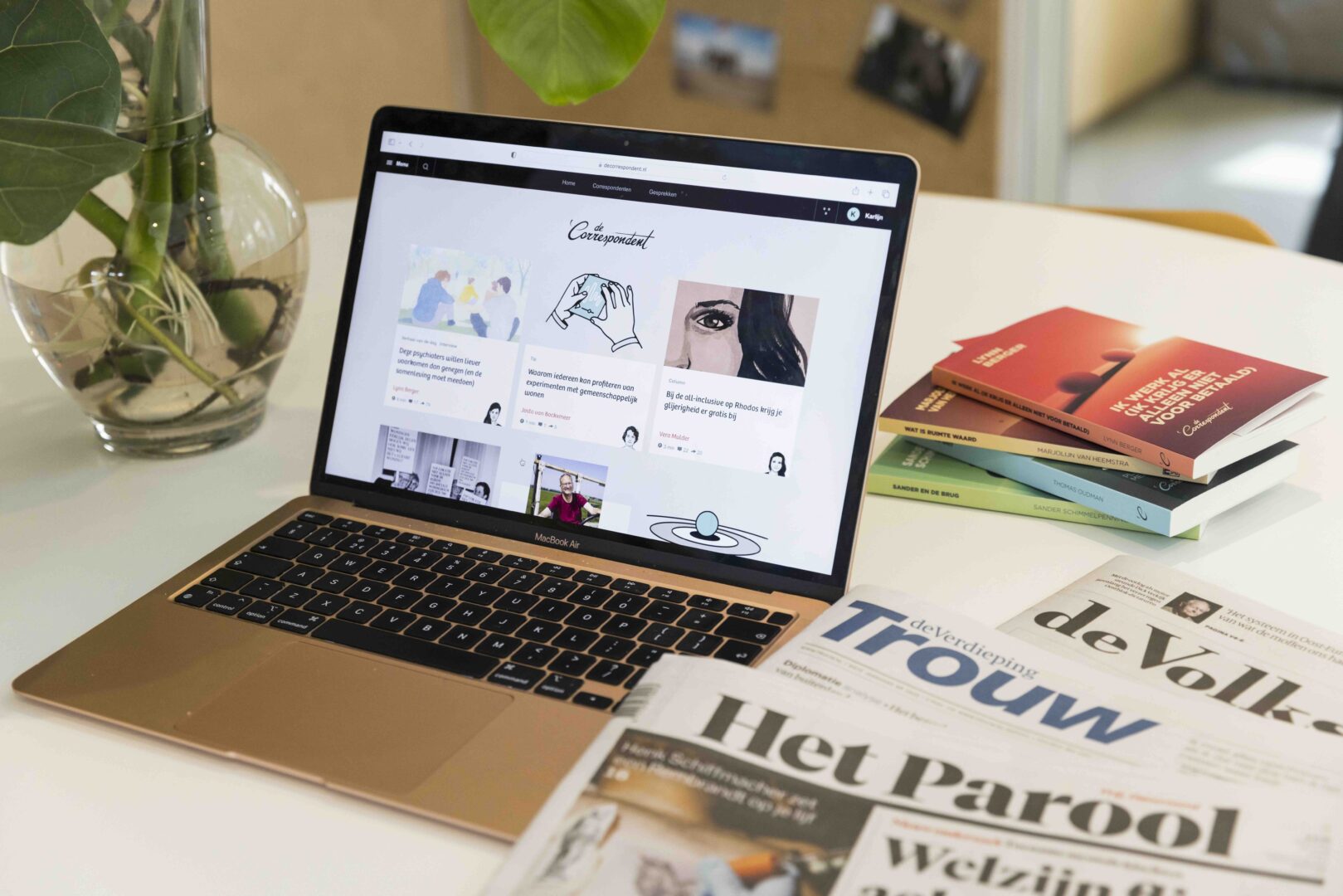
4. We don’t just tell you what the problem is; we also tell you what we can do about it.
Well, bring it on—what can we do about the problems in journalism?
“Everything that makes you less dependent on Musk’s whims and algorithms—and everything that strengthens journalism as a public service. That could include building a relationship with your own audience, through newsletters, for example. I also think we need to constantly raise people’s awareness of the importance of journalism. We end everything we share online with the line: “Independent journalism depends on you.” People don’t usually think about the social function of journalism, but if you help them understand it, they’re willing to commit to it. And we have to keep looking beyond the paywall. We mustn’t let an information gap emerge—where people who can afford it get quality information, while those who can’t are left at the mercy of free nonsense.’
5. We work together with you, our expert members.
Will that work in practice?
“Sometimes yes, sometimes no. It works when the question is specific and the area of expertise is clear. For example: when you ask about teachers’ experiences in the classroom. It doesn’t work when you ask about topics that are highly politicized or don’t really have a specific expert as the authority on the subject. Then you mostly get opinions. But there’s no doubt that readers possess a great deal of knowledge. I think the methods for drawing that knowledge out are still far from fully developed.”
6. We don’t pretend that we “neutral,” but we’re transparent about our worldview.
How do you ensure that a group of correspondents, each with their own unique profile, still come together to form De Correspondent?
“That’s the hardest part of the whole endeavor. And it’s also the most fun—finding the right people. Of course, I make sure it doesn’t turn into a cabinet of curiosities. At one point, we had a guest correspondent named Melk. That’s when I drew the line. It’s about recognizing those broad, underreported, and solvable issues—and then you also have to be able to tell the story well or write it down effectively. It’s hard to find people who can do this really well. It’s not ingrained in journalism, and journalism schools are mainly practically oriented. It’s more about “how you do it,” but not “what you’re writing about.” Sometimes it feels like looking for a needle in a haystack. But when you find one, the search is more than worth it.’
7. We protect your privacy by collecting as little information about you as possible.
Do you know if you’re reaching the people you want to reach?
“We don’t know nearly as much about our members as we could; that’s a conscious choice because it involves people’s privacy. We do conduct more targeted research, such as surveys. And our reach is still growing. There’s always room for improvement, but we’re committed to this principle. Many online services are free because, as a user, you pay for them by giving up privacy-sensitive data. We don’t want that.”
8. We want to be as inclusive as possible.
What does inclusivity mean to you?
“What matters most to me is whether our correspondents offer a fresh, innovative perspective on a relevant topic. Our “Existential Insecurity” correspondent, Tim ’S Jongers, comes from a background of extreme poverty. He looks at something that, for most people, is just a topic in the newspaper—but not a reality they’ve lived through themselves—in a completely different way. That, too, is a form of diversity. Incidentally, it’s no easy task to find people who are both different and a good fit for you.”
9. We always prioritize journalism over financial gain.
Your profit distribution should never exceed 5 percent of revenue. De Volkskrant and NRC, however, are aiming for higher profits. Will that come at the expense of the quality of their journalism?
“There’s nothing wrong with striving for profit. De Correspondent is also a private limited company. That was a very deliberate choice, because if it isn’t profitable, you’re perpetuating something that has no right to exist. But we don’t engage in profit maximization. At the larger media conglomerates, a significant portion of the profits goes to shareholders or other divisions of the company, but not automatically toward, for example, a larger investigative news team or better rates for freelancers.”
10. We believe in transparency and continuous self-improvement; we do not consider ourselves the solution to everything that is wrong in ““the media.”
Why so modest?
“Because only your actions prove that you’ve accomplished something. If you act like you have a monopoly on the truth, that holds you back from continuing to grow. And I think humility fuels new things. Of course I’m proud of what we create and who we are, but I’m always asking myself, ‘What’s next?’ I’m nowhere near done yet.”
The Democracy and Media Foundation holds a 10 percent preferred stake in De Correspondent B.V. As a non-profit shareholder, SDM does not receive dividends.
News and articles